The 3 Keys to Healthy Aging

I have an irrational distaste for going to the doctor. Of course, if I really have to go, then I will. (I’m not like my grandmother who absolutely loved going to her doctor’s appointments and all the attention she got there.) So I do everything I can for my healthy aging. It turns out that there are 3 keys to healthy aging that all work together.

Diet is first

The first of the keys to healthy aging is diet. Your nutrition, what you eat, affects everything you do. Your diet affects your brains, your bones, and muscles. Eating a healthy diet has been shown to reduce your risk of heart disease, stroke and cancer, among other health concerns. It also affects your mental health. Eating well can lessen your likelihood of developing depression or anxiety. If you eat a healthy diet, you’re more likely to keep to an exercise plan. And you’ll sleep better. What you eat can determine the amount and quality of your sleep.

Number 2: Exercise
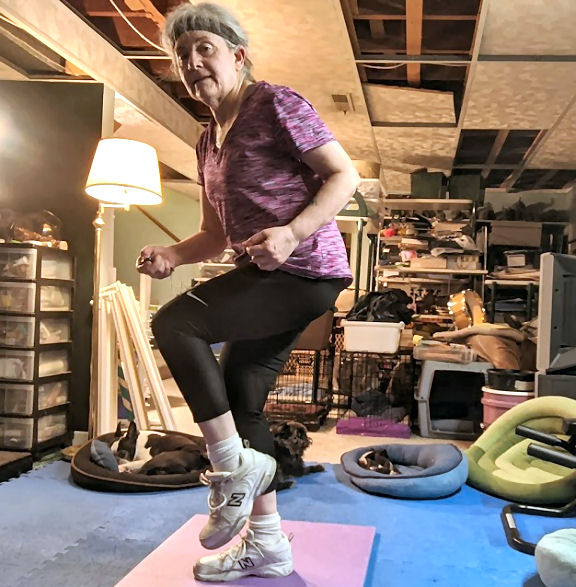
Exercise is the second key to healthy aging. The benefits gained from exercise are for every age. From lower blood pressure to stronger bones to better mental clarity, exercise is essential. And every type of exercise can help to improve your sleep. Of course, exercising closer to bedtime could make it more difficult to fall asleep. I always have more energy after I exercise, so I don’t even try to take a nap after a workout.

Sleep is Last But Not Least

And sleep is the third key. Sleep gives your body and your brain time to recover from the day’s exertions. Without proper quality sleep, you have a higher risk of certain conditions like stroke, heart disease and diabetes. When you get enough sleep, you have better energy for all the activities you love doing during the day. 

They all work together. The 3 keys to healthy aging make you more resilient and able to tackle everything life throws at you. Sleep and a good diet gives you the energy to exercise. Exercise and sleep help you make good choices, both in your diet and in the rest of your life. And, of course, diet and exercise keep you healthy and happy.
Exercise for mental health – is it enough?

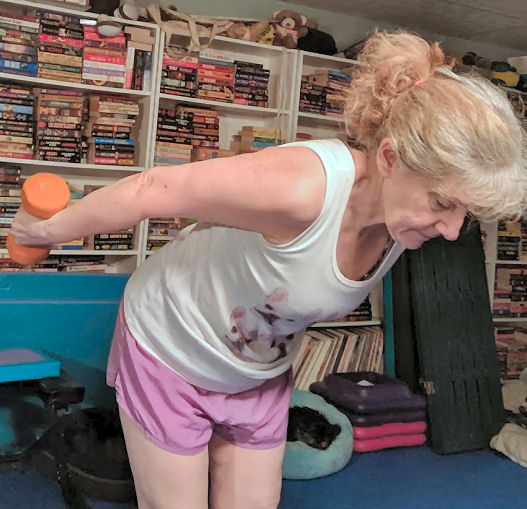
I’ve mentioned that exercise will boost your optimism, improve your memory and make you more resilient. Exercise is also important for healthy aging. All that’s still true. But is exercise for mental health enough? Perhaps. I’ve mentioned that I exercise to be a nicer person. I exercise to work out my frustrations and anger. But I also exercise so I can eat. And I run to make navigating an agility course with my dog a little easier.

I don’t want to plateau

I don’t enjoy exercise. And for me, exercising for my mental health would not be enough. So I push myself. But everyone is different, and if you exercise strictly for the mental health benefits, you’ll still sweat and get endorphin rush from aerobic activity. But if you don’t push yourself, do one more repetition, run an extra hundred yards, push the speed a little, or the incline, you’ll reach a plateau in your physical conditioning. That may not matter to you.

Progressive overload

But if hitting a plateau is not in your makeup, and you want more from your exercise, then you’re like me. You’ll push a little harder, run a little further, lift a bit more. The experts call this “progressive overload.” By gradually increasing the difficulty or intensity of your workouts, you become stronger, faster, and more fit. The term is usually applied to strength training, but it can be used for any kind of workout. And by gradually increasing the difficulty, you’re continually challenging yourself. 

Gradually increase your speed or reps

Trainer Chad Barribeau, CSCS, says, “A good rule of thumb is to increase your workout load (whether weight, reps, distance, or speed) by 10 percent or less each week. This can ensure you’re challenging yourself while controlling your risk of injury or burnout.” Slow and steady increases will produce gains in your physical fitness without the soreness we frequently experience from doing too much too soon. So, slow and steady really can win the race.

Me? I’m greedy. I want it all. I want the happiness and release of frustration that the endorphins produced by a good workout bring me. And I also want the speed and strength I get from conditioning my body.

Just one more!

I don’t know too many people who are excited to exercise. I’m not. I do it because the benefits I get from exercise allow me to do the things I actually want to do. But I know that in order for the exercise to keep giving me those benefits, I have to keep challenging myself. You probably know that many days I do my workouts with a pre-recorded program. I pick up my weights and follow along. As the years have gone by, I’ve increased the intensity and the weights I use. I’ve gotten stronger, and the old weights were no longer challenging. I also want to be able to do more regular push-ups because I want to get stronger. To motivate myself, I tell myself, “Just one more!”

The key to motivation

And that’s the key to motivation. “Just one more” can be your watchword, your spark, for anything you’ve got in your sights. One more pound to lift. Run another tenth of a mile. Walk one more block. Write another chapter. Knit another row. The sky’s the limit when you tell yourself, “Just one more!”

Stagnation is the worst thing

I believe that the worst thing we can do is stagnate. If we don’t grow, if we don’t evolve, then I think we can just dig a hole and get comfortable there. By growing and developing new talents we learn more about ourselves and the world.

Develop a “growth mindset”

And in challenging ourselves, we develop what’s known as a “growth mindset.” We aren’t satisfied with the way things are now, with ourselves. We know that we can be better. We can become more fit, for ourselves and the people who love us. And we can explore more things. We’re not satisfied with our current knowledge base. Sometimes that’s scary. But by learning more about the things that scare us they lose the aspects that we fear. We can bounce back and become more resilient as fewer things scare us. Sure, there are other scary things out there, but we may have to look harder for them.

When we can do “Just one more,” then perhaps we can do two more, and conquer the world that much faster.

Don’t use fear as a motivator

It’s Fall – when we strive to prevent falls

It’s officially Fall according to the calendar, and my reminder to focus on my balance exercises. It’s an unkind fact – as we get older we not only gain more wisdom (that’s a good thing), we also lose things. Like our eyesight, our hearing, our hair (for some), our bone density, and our sense of balance. Falls are a primary cause of sending us seniors to the hospital. And once we’ve fallen, we live in fear of falling again. We may not be able to do much about our eyesight and hearing, but we can work to improve our balance. Fear of falling is a powerful nudge to get us working on our balance, but don’t use fear as a motivator.

Negative motivators are powerful

Fear has been called the most powerful motivator to get us to do something. And it certainly works. For a while. But we become fatigued. We can’t live in fear day in and day out. It’s not enough to be afraid of falling to get us to do the simple balance exercises. Fear tends to paralyze us. And if we don’t fall one day, or two, or a week, then we lose the motivation. We’re still afraid of falling, because the memory is there, but it’s no longer so powerful.

I learned a lot about aging

I started my balance journey a number of years ago after I fell and injured my knee and hips. It’s true that knowing our balance diminishes is often not enough to get us to work on it, though. In fact, I didn’t know about that aspect of aging until I started doing some research. I didn’t like the fact that losing balance is a natural part of aging, so I decided to see if there was something to do about it. Happily, I also learned that simple exercises (you can do the Core-Centered Balance Moves too) can help us regain the balance we’ve lost over time. This is a long-term prospect. Much like general exercises for the rest of our bodies, the benefits are lost if we don’t do them and they’re cumulative if we keep on doing the exercises. So we need additional motivation to keep us working on our balance.

Negative motivators are exhausting

But fear is a negative motivator, which never works as well as positive ones over time. Negative motivators are tiring. They’re unsustainable. Negative motivators work really well in the short term – like making you hurry if you’re late to an appointment and fear the consequences. Negative motivators are great at getting you to avoid doing things – like going out of your house if you’re afraid of falling. Positive motivators work much better in the long run at helping you to take action. You’ll want to go places and visit friends and family if you’re confident that you can do so safely. You’ll be able to bounce back and be more resilient if you’re confident in your independence.

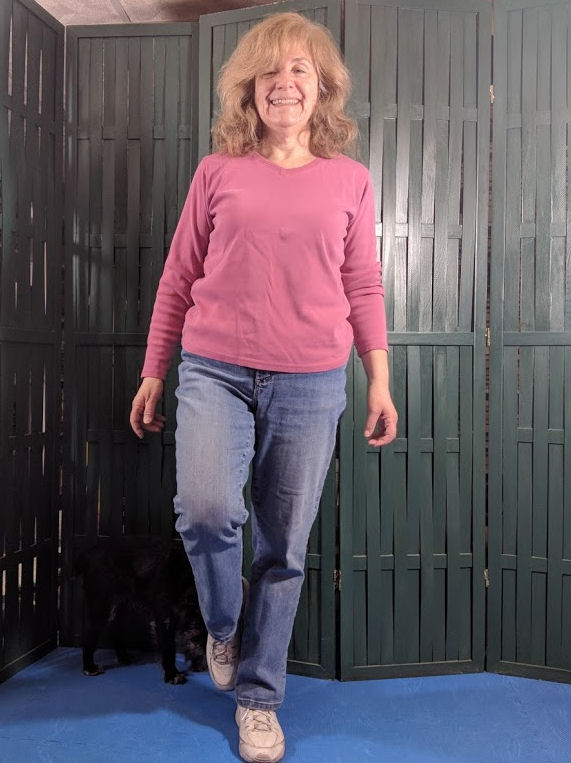
So don’t use fear as a motivator to practice your balance moves. Instead, think of the confidence you’ll gain by your improved balance. You can step out of your door with confidence. You’ll revel in your independence. You’ll know that even if you do step on uneven pavement, the Inline Walking exercise that you do every week (yes, I know it looks and feels weird) will help you keep your balance. 

It’s just two minutes a day. Practice your balance. Be confident.

Third type of motivation

A while ago I told you about 2 kinds of motivation – extrinsic and intrinsic. External and internal motivation – your motivation is fueled by outer forces, or you’re motivated because you enjoy the project. But, that doesn’t explain how people who do not like to exercise still get up, change their shoes and work out five days a week. The benefits of exercise don’t matter. When it comes to doing a bunch of burpees and getting hot and sweaty, I don’t care if this will help me remember things. I’d rather do a Sudoku puzzle. My heart is fine, thank you. My healthy aging? Doing great, thanks. And as long as I can zip my jeans, my weight is good.

What makes mundane tasks more motivating?

So here’s where the third type of motivation comes in. The Harvard Business Review did a study on how to make even the most mundane tasks more motivating. And you might be surprised at the results.

Do it for others

Do it for others. You’re part of a team. When you exercise, you make an investment in yourself. Your family needs and depends on you. You exercise for them. And that’s the third type of motivation. The motivation that inspires you to go above and beyond what you think you’re capable of. The thing that makes you push beyond what you thought were your boundaries. You can achieve more than you ever thought possible when you do things for the people in your life who you love, and who love you.

Your secret weapon

The third type of motivation goes much further than intrinsic or extrinsic motivation. This motivation brings in a secret weapon – other people. You can use these other people as your exercise team. Some people are able to sustain exercise when they do it with others, either as part of a group class or an accountability group. When I took group step classes, for example, I was able to forget how out of breath I was. The music and cheering of others lifted me up and kept me going. My classmates, or my team, motivated me to continue stepping, jumping, and lunging past the point where I might have stopped.

Your accountability team can also keep you going. If you have a group that checks in with each other once a day, for example, you know that you’re going to have to tell them that you worked out for a half hour or 45 minutes, or an hour. Or you have to tell them that you wussed out and didn’t exercise. Most times peer pressure motivates us to do the thing we really don’t want to do.

If you really like to exercise – great! Do it. If the benefits you get from exercise motivate you to work out, that’s good too. But if these types of motivation just aren’t doing it for you, you can rely on the third type of motivation to get you up and moving. Exercise for others.

I changed the time I run – What happened?

Changing the time I ran really made a difference.

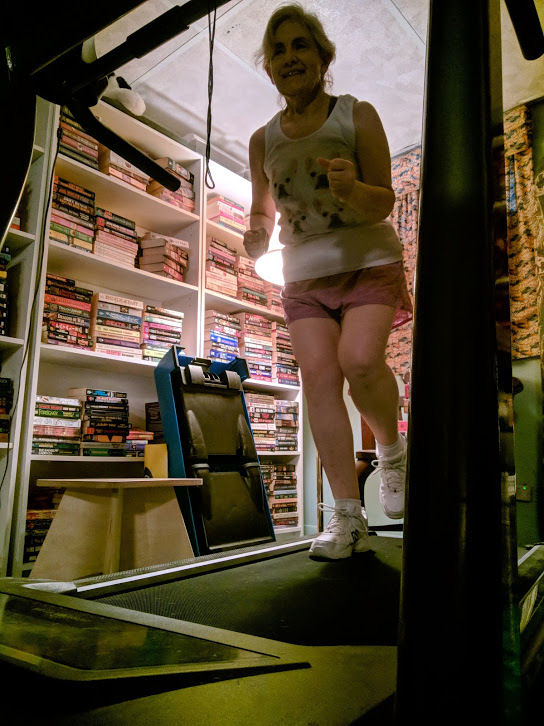
I’ve written before that no matter what time of day you exercise, you’ll still get benefits. The important thing is that you exercise! And that’s true. My preference is to exercise early in the day because I feel so energized afterward. I’ve had to adjust to working out in the late afternoon, after work, though. But I had to switch my schedule last week on a running day to go into work later. I thought it would be interesting to see the effect of changing the time I ran. I usually run twice a week on the treadmill, because I think running outside is even worse than running on the treadmill. The only thing that makes running even tolerable is listening to a fast-moving action novel. No self-help or memoir for the treadmill. If I’m engrossed in the story, then I’m not ticking away the seconds on the treadmill timer.

Why run if it’s so hard?

Why do I run at all if it’s so hard for me? I like to play sports with my dogs – and running agility is just that – running. So I run for endurance and to try to be in the right place to give my dog the cues he needs.

Changing the time I ran made a big difference

My afternoon runs had been getting steadily faster and the intervals longer. The total time remained the same, but in those 20 minutes, the time I took to slow down between fast intervals was less. What a shocker, then, when I ran in the morning last Thursday! Changing the time I ran made a big difference in how I felt. 

Running early was so much harder than I thought it would be. My legs felt like lead pipes. My lungs were burning inside of 5 minutes. I couldn’t go as fast as I could just a few days before. The incline was excruciating. So I backed off. I ran more slowly. I shortened the fast interval. I decreased the incline. And I made arrangements to run early every Thursday, because the higher levels of Agility are run early in the day. If I’m going to be able to compete, I have to be able to run early. So I’ll train for it. I’m changing the time I run to get ready for competition.

Time of day actually does matter

As it turns out, though, the time of day does seem to matter in the actual results you might see. A recent study by researchers at Skidmore College showed that women who exercised in the morning had greater fat loss. Women who trained later in the evening gained more upper body strength and power. There was little difference in performance improvement in men.

All exercise will give you benefits for our healthy aging such as heart health, better sleep and improvements in your mood. But if you ladies want to lose more fat, try working out early!

A specific exercise for a specific memory?

Aerobic exercise to boost certain memories?

It could be that in the future, if you want to remember your shopping list at the grocery store without having to check your phone, you would do a specific group of exercises! Way, way in the future, so don’t get your hopes up. But new research has shown that certain types of exercise helped study participants in remembering certain types of data. We do know that exercise has benefits for our brain and mental health, but this is much more specific than we had previously thought. The thinking that if we do a specific exercise for a specific memory boost is remarkable.

Exercise improves brain health

It’s been shown that exercise improves memory on a general level, even after a single workout. And, on a long-term basis, exercise improves overall brain health. And studies have shown that over time exercise is associated with a reduced risk of brain health problems such as dementia and Alzheimer’s disease, both concerns for our healthy aging.

Different feelings after different workouts

I know that I feel differently after a run, for example, than after a Pilates session. I’m more energized (and sweaty) and outwardly happy after doing my run / walk workout. After a Pilates session, I feel calm, with a happy buzz. But I must admit that I hadn’t noticed specific memory improvements. I know that right after a workout I can remember some things better but hadn’t noted which “things!”

Correlation between exercise and memory

This research study by Dartmouth, published in Nature, delves into the correlation between exercise and memory. This was a relatively small study with only 113 participants, but the results are interesting. Fitbit data was analyzed after participants were given various types of memory tests post-workout. Researchers looked for patterns between those results and the workouts the participants did. 

Not surprisingly, the study showed that overall the more active people had better memories than the non-active people. But it also showed that high-intensity exercise was correlated with good performance on the “spatial-learning task” (remembering the positions of shapes on a screen). “Low-to-moderate-intensity” cardio activity, like going for a walk, was associated with improved “naturalistic recall” (remembering a narrative of events). And people who performed better on the foreign-language test “tended to be less active,” the report added, while participants who did well on free recall and naturalistic recall were more active.

So, this study supports previous research on exercise and memory, but it also presents a focus for future work needed. Could there be a specific exercise for a specific memory? Time and research will tell. I’ll be looking forward to reading the results.

I needed to release frustration

Pissed off! I got an unwelcome piece of mail a couple of days ago and was totally steamed by it. My company received a notice from the IRS about a penalty charged for late filing of a return. I knew that the return was filed on time, so I was angry. That turned into an overall bad mood. I knew that I needed to calm down to deal with this (in a day or two) because I had to give my 14-year-old dog a bath that day. I had to be calm and gentle with my dog. Not rip his legs off as I felt like in the moment. What’s the solution? A really intense workout to help release frustration and anger.

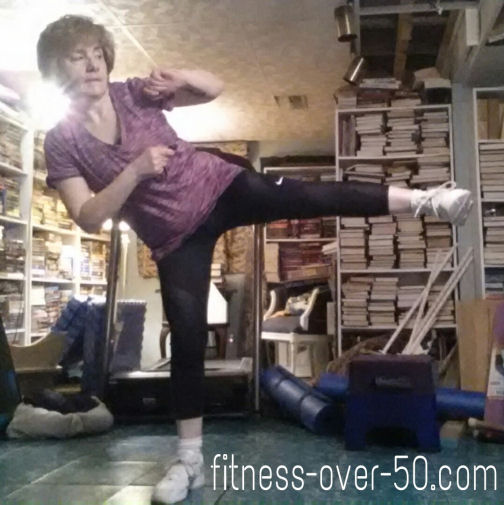
Kick boxing to the rescue

I chose a short (because I had things to do, obviously) but intense kick boxing program. Pump up the heart rate, get the sweat going and release the frustration.

The workout started with a warmup to let my muscles know they were going to have to do some work. And then eased into punches and kicks..

Mission accomplished

When that half hour was done, I was a sweaty mess, but I achieved my goal to workout to release the frustration. My mood was very much improved and I was able to give Tango a nice calming bath.

How does that work?

Side kick in a Turbo Jam workout

You’ve heard the phrase, “runner’s high?” Same thing works with other exercise that targets the cardiovascular system. Raise your heart rate for a sustained period of time, and your body releases endorphins. Those endorphins attach to your opioid receptors, causing a boost to your mood

So, my immediate mission was accomplished – I wouldn’t kill Tango during his bath – but I also did other good things for myself. I’ve written that exercise not only improves your mood but also has other benefits for our healthy aging: it improves memory, helps you sleep better, and improves optimism and resilience. Not only does a great workout release frustration and anger immediately, but it has other longer-lasting benefits.

All’s well

I dealt with the IRS and the agent I spoke with removed the penalty. I bathed my dog. And I was able to release frustration and anger. A good day.

3 Short methods to maintain your momentum

If it's a struggle every day to put on those sneakers, here are 3 methods to maintain your momentum.
Is it a struggle to put on those sneakers?

I get it. I do. You’ve been exercising for weeks and it’s dull. You’ve made good progress but it’s a struggle every day to put on those sneakers. So, how can you maintain your momentum and not sit back on the couch? How can you keep that appointment with yourself and exercise? Yes, you know that it’s good for your healthy aging. You know that it’s good for your brain, your memory, your cognition and your sleep. That doesn’t make it easy to change into that workout gear. Some days you just don’t care about your resilience and how much exercise will help you through anything. You just feel like taking a nap. So here are 3 methods to maintain your momentum.

1st method to maintain your momentum:

Know that it’s OK to play hooky once in a while. If you just can’t face that treadmill or put that exercise bra on, it’s OK not to.

Just the fact that you know it’s all right to skip a day will, most likely, get you up off the couch. Ask yourself the question: do I want to play my hooky card today? Or should I save it for when I REALLY don’t feel like working out? 

2nd method:

Remember your kids, or your dogs, or your friends. They’re waiting for you. Remember why you started exercising in the first place. You want to run around with the kids and grandkids. Take fun vacations with them. You want to play with the dogs – get down on the floor to play and still be able to get back up again. And you want to roam all over the mall with your friends without having to take breaks.

3rd method:

Know that you’re going to be very sore if you take days off.That’s not fun. 

As we age, the recovery time for our muscles extends because our muscle tissue takes longer to repair itself and rebuild. It’s just easier to do the workout. And, face it – with the time you spend arguing with yourself whether or not to workout you could be almost finished with today’s workout. 

So, get off the couch.

5 reasons to do planks

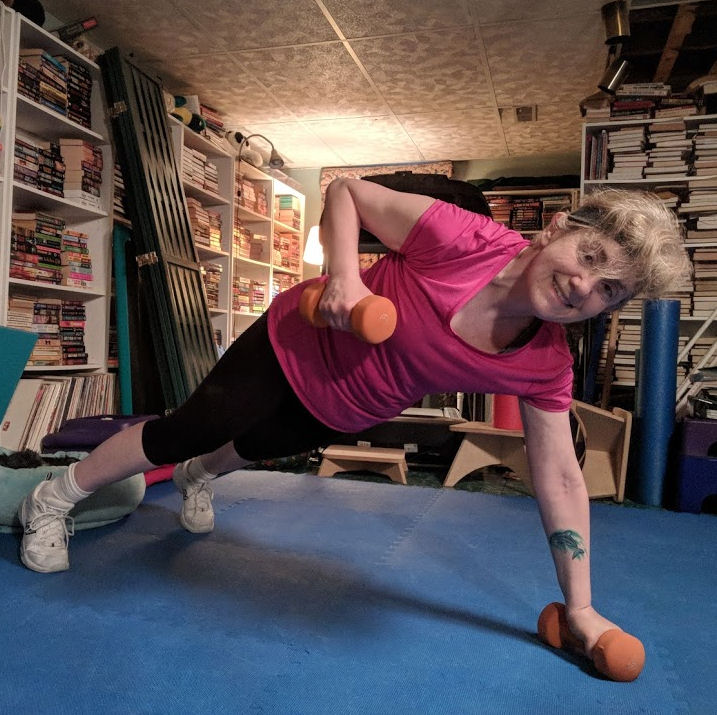
Renegade row - one of the killer moves in Saturday's workout
One plank variation

Planks have gone in and out of favor in the fitness community for years. But there’s a definite place for planks in everyone’s exercise regime. You know I always advocate a strong core. So we’ll take it as a given that the prime reason to do planks is to strengthen your core. Here are more reasons to do planks.

Reason to do planks #1 – simplicity

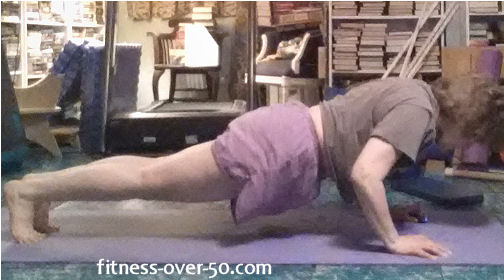
Planks are simple. Anyone and everyone can do some version of a plank. If you’ve been doing them for a while, the standard plank on your hands and toes is your go-to exercise. But for beginners, I’d recommend starting using a coffee table. Put your hands flat on the edge of the table, walk your feet back until you’re in a straight line from your heels to your head. Core pulled in tight, back straight – don’t arch your back or bow it. And hold there for 15 seconds to a minute. As you feel stronger, go down to the floor. You can start on your knees and hands first, but you’ll want to progress quickly to an elbow plank. On your toes and your forearms – keep that straight line from your heels to your head.

Reason #2 – core stability

Planks not only strengthen your core, but they’ll give your core stability. Core stability is what keeps us upright as we go through the day, transfers energy from our upper to our lower body and protects our spine. It’s also what gives us good balance – which, as I’ve emphasized before, nature takes away as we age. I hold a plank a few times a week for my healthy aging – and perhaps you should, too!

Reason #3 – entire body workout

Planks work our entire body, not just the core. If you’re doing a plank correctly, you’ll feel it in your legs and shoulders. Your glutes get a good workout, and your arms are holding you up, so they’re getting stronger too.

Reason #4 – builds muscle endurance

Planks are isometric. Planks are static exercises – we hold the position for at least 15 seconds up to a full minute. So holding the position is building not just strength, but the endurance of the muscles. We sit at our computers all day, so we need that endurance to hold us upright.

Reason #5 – practically endless variations

The variations of planks are practically endless, so we’re never bored with our planks.One way to make a regular plank more dynamic is to alternate shoulder taps – but keep your hips level. Another of my favorite plank variation is the side plank – lift your leg to make a star!

With all these reasons to do planks, perhaps you should add it to your exercise regimen.