Get mobile

I turn 71 next week. Scary. If there’s one thing I’ve learned, researching fitness topics over the years, it’s that we all want to maintain our independence as we age. We want to be able to do the things we want to do when we want to do them and not be tied to someone else’s schedule. This increases our resilience. And, of course, ties into our healthy aging goals. We need to be mobile, to maintain our balance, and have the strength to carry ourselves and the stuff we take out of or into our homes. You know that I’m a fierce balance advocate. (Join the Balance for Fitness, Balance for Life group on Facebook for daily 2-minute exercise recommendations.) And I’ve talked about incorporating strength work into the exercise programs we do. But what does it mean to get mobile?

Joint mobility means how well an individual joint or a group of joints—like your shoulders or hips—can move. A healthy joint is able to move more and move better, and it’s less likely to cause pain or get injured, according to the Silver Sneakers blog. But how well we move throughout the day requires full body mobility, and that means that all our parts have to work well together.

We need good posture to keep our back straight and shoulders unhunched, a strong core for power. And we need good balance to keep us sure-footed.

Flexibility helps with that movement. If we can touch our toes, then our hips and legs are working. But to truly get mobile, we’ll need some more dynamic exercises that work multiple parts at once. Lunges get those legs working. Go slow and easy with them at first, making sure your knees don’t go past 90 degrees. If you can see your shoelaces over your knee, you’re doing well. If you need a stick to help at first, use it. Do 8 to 10 on each side.

Another good mobility exercise is bird dog. On all fours with hands directly below shoulders and knees directly below hips, lift opposite limbs. Left arm and right leg. And hold for a bit. Lower slowly and switch. Do 8 to 10 of those.

Chair pose works the core. Tighten it, stand with feet shoulder width apart, raise your arms for counterbalance and lower down as if you’re hovering over a chair. Hold for about 5 breaths and stand up. Repeat a few more times.

These are just a couple of mobility exercises. There are so many more. Don’t forget that a part of staying independent is to get mobile.
Not wanting to do something is not a good excuse

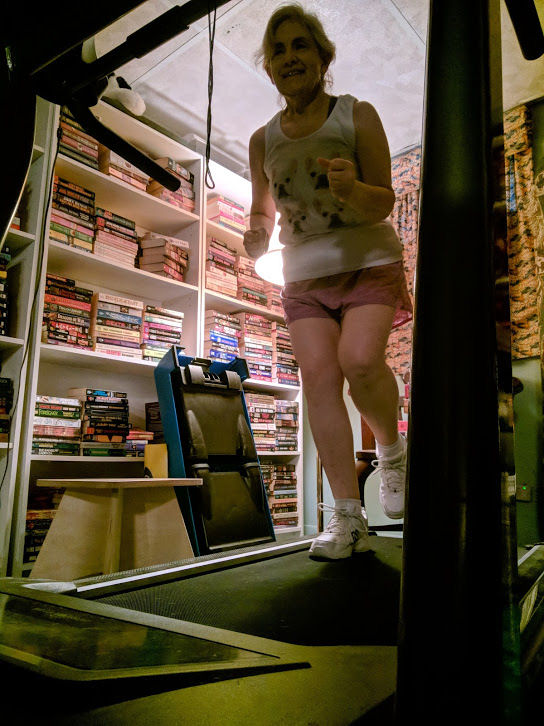
I never want to exercise. Honestly. I’ve said it before, and I’ll keep saying it because it’s true. I was working at a dog obedience trial all day on Sunday – if you’ve never been to one, it’s amazing watching the amazing teams. Anyway, I was on my feet all day, and the last thing I wanted to do on Monday was get on the treadmill. But not wanting to do something is not a good excuse for not doing it. So I did it.

Of course, there are plenty of reasons that you don’t exercise on any given day. You might be sick with a chest cold. Or you have an important appointment that you can’t miss at the time you originally scheduled to work out. Or you have to take the dog to the vet. Those are certainly valid reasons to not exercise.

Take a walk. Create a healthy habit.

But on normal days – what’s the motivation to get you exercising when you don’t feel like it? How do you talk yourself into doing something when you don’t want to? I thought about how I’d feel when I was done. It was a slog, and I probably didn’t give it my all the way I usually do, but I did it. Over a mile at 10 percent incline, over 4 miles per hour. And I was so grateful when the time was up. But I felt completely virtuous.

I also was at an exciting part of the book I’m listening to. The one thing that keeps me getting back on the treadmill is listening to audiobooks. No self-help or non-fiction for me, either. It’s got to be something that holds my attention. It’s great escape so I don’t think about how much I dislike what I’m doing.

I also think about how doing the treadmill thing works into my overall fitness goal. Maintaining my endurance keeps me getting back on. I want to be able to play with my dogs for many years to come. Having that endurance also ensures my independence. So I keep getting on the treadmill and working out..

The site, “Time For Your Life” also suggests breaking down the thing you don’t want to do into “laughably small steps” so that it’s completely painless. Like setting a timer for 5 minutes to get started on something you don’t want to do. I completely agree. I tell people to just start to exercise when they don’t want to. If you still don’t want to exercise after 5 minutes, then it’s okay to think about quitting.

But just not wanting to do something is not a good excuse.

We can be as flexible as we want to be

As flexible as we want to be

Do you look back fondly on the days you could tie your shoes without sitting down? Don’t accept as a fact that you’ll never be as flexible as that again. It might take some time, thought, and care, but we folks over 50 can be as flexible as we want to be. In fact, when done with focus, stretching can help us avoid pain. As an example, if the muscles in the front of your legs are too tight, it can lead to movement limitation in our pelvis and hips which can lead to lower back pain. 

Becoming flexible can help prevent muscle and disk strains, shoulder strains, and backaches, according to WebMD. Working on your flexibility is also good for improving your balance. But don’t try to touch your toes the first time you try a stretching routine unless you’ve been doing that for a while. Start slowly and work your way up to the big stuff. 

Static stretches first

You may want to start with static stretches – that is, holding a position for up to 30 seconds and then relaxing. And repeat a couple more times. But don’t bounce into the position – this can lead to injury.

Isometric Stretches

Isometric stretches are similar, but when you’re in the position, contract the muscle you’re stretching. Contract and release a few times while you’re holding. This can be hard, since we’re not always aware of the specific muscles we’re working. I know I’m not.

Dynamic Stretches

Dynamic stretches incorporate movement. Things like head rolls, leg swings, hip circles, and walking lunges are examples of dynamic stretches. Repeat for a certain number of repetitions, say 10 or 12.

If you decide that you want to incorporate stretches into your daily routine, decide when you want to do them and stick to a plan. 

We’ve talked about goals and plans before – make sure that your plan is reasonable and achievable. Decide on the specific stretches you want to do, and reassess after a few weeks to make sure that you’re still getting benefits from your new routine. If you want to delve deeper, you can check out classes that focus on stretching and flexibility like Pilates, Yoga, and Tai Chi.

Use the stream for your fitness

We’re all so used to that little circle in the corner of our screens now – the commercial count-down. Those commercials are annoying, yes, but rather than be annoyed, use the stream for your fitness. 

Social media calls this movement snacking – the idea is to move in the time it would take you to get a snack. This snack can counteract the effects of sitting too long. You know the feeling – when your knees and back are stiff when you stand up, you know you’ve been sitting too long. My sister and I tell each other to stand up at our desks when we’ve been deep in concentration all morning. And when we forget, if one of us gets up and our knees are stiff, we exclaim that we’ve been sitting for too long.

And these short bursts of activity can help regulate your blood sugar, boost your circulation, and enhance your focus. 

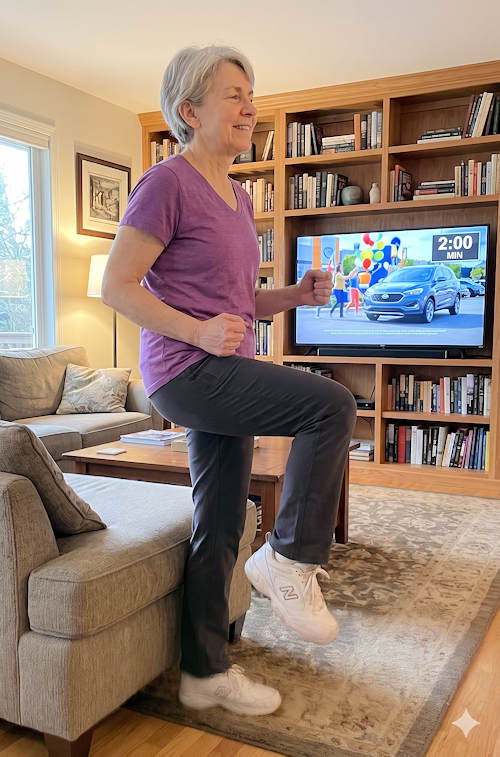
Your movement snack can be as simple as just standing up and sitting down (without using your hands, of course) for the 90 seconds or so of the commercial break. Stepping from side to side is another good move. Marching in place with raised knees will get your heart rate up a little too. If the commercial has good music, dance to it. That’s a great movement snack. It really doesn’t matter what exercise you do, as long as you get up and do something. And if getting up isn’t an option, then sit up straight and move your feet side to side. Raise your arms overhead and lower them. Do some biceps curls even if you don’t have weights. Make a fist.

After consuming these movement snacks, you’ll also find that your energy level is higher. It could be that you may not fall asleep on the couch after dinner. 
If there’s no commercial timer on the stream, just set your phone’s timer for 2 minutes. I’ll bet you’ll see a difference in how you feel with just a few days of using the stream for your fitness. You’re doing something good for your healthy aging and your resilience. In just a few days, you’re creating a great healthy habit. This is a good way to practice self-care. You’re making sure that you’ll be around for those who need you.