I turn 71 next week. Scary. If there’s one thing I’ve learned, researching fitness topics over the years, it’s that we all want to maintain our independence as we age. We want to be able to do the things we want to do when we want to do them and not be tied to someone else’s schedule. This increases our resilience. And, of course, ties into our healthy aging goals. We need to be mobile, to maintain our balance, and have the strength to carry ourselves and the stuff we take out of or into our homes. You know that I’m a fierce balance advocate. (Join the Balance for Fitness, Balance for Life group on Facebook for daily 2-minute exercise recommendations.) And I’ve talked about incorporating strength work into the exercise programs we do. But what does it mean to get mobile?
Joint mobility means how well an individual joint or a group of joints—like your shoulders or hips—can move. A healthy joint is able to move more and move better, and it’s less likely to cause pain or get injured, according to the Silver Sneakers blog. But how well we move throughout the day requires full body mobility, and that means that all our parts have to work well together.
We need good posture to keep our back straight and shoulders unhunched, a strong core for power. And we need good balance to keep us sure-footed.
Flexibility helps with that movement. If we can touch our toes, then our hips and legs are working. But to truly get mobile, we’ll need some more dynamic exercises that work multiple parts at once. Lunges get those legs working. Go slow and easy with them at first, making sure your knees don’t go past 90 degrees. If you can see your shoelaces over your knee, you’re doing well. If you need a stick to help at first, use it. Do 8 to 10 on each side.
Another good mobility exercise is bird dog. On all fours with hands directly below shoulders and knees directly below hips, lift opposite limbs. Left arm and right leg. And hold for a bit. Lower slowly and switch. Do 8 to 10 of those.
Chair pose works the core. Tighten it, stand with feet shoulder width apart, raise your arms for counterbalance and lower down as if you’re hovering over a chair. Hold for about 5 breaths and stand up. Repeat a few more times.
These are just a couple of mobility exercises. There are so many more. Don’t forget that a part of staying independent is to get mobile.
Do you look back fondly on the days you could tie your shoes without sitting down? Don’t accept as a fact that you’ll never be as flexible as that again. It might take some time, thought, and care, but we folks over 50 can be as flexible as we want to be. In fact, when done with focus, stretching can help us avoid pain. As an example, if the muscles in the front of your legs are too tight, it can lead to movement limitation in our pelvis and hips which can lead to lower back pain.
Becoming flexible can help prevent muscle and disk strains, shoulder strains, and backaches, according to WebMD. Working on your flexibility is also good for improving your balance. But don’t try to touch your toes the first time you try a stretching routine unless you’ve been doing that for a while. Start slowly and work your way up to the big stuff.
Static stretches first
You may want to start with static stretches – that is, holding a position for up to 30 seconds and then relaxing. And repeat a couple more times. But don’t bounce into the position – this can lead to injury.
Isometric Stretches
Isometric stretches are similar, but when you’re in the position, contract the muscle you’re stretching. Contract and release a few times while you’re holding. This can be hard, since we’re not always aware of the specific muscles we’re working. I know I’m not.
Dynamic Stretches
Dynamic stretches incorporate movement. Things like head rolls, leg swings, hip circles, and walking lunges are examples of dynamic stretches. Repeat for a certain number of repetitions, say 10 or 12.
If you decide that you want to incorporate stretches into your daily routine, decide when you want to do them and stick to a plan.
We’ve talked about goals and plans before – make sure that your plan is reasonable and achievable. Decide on the specific stretches you want to do, and reassess after a few weeks to make sure that you’re still getting benefits from your new routine. If you want to delve deeper, you can check out classes that focus on stretching and flexibility like Pilates, Yoga, and Tai Chi.
How much time do you spend waiting in your kitchen? Waiting for the microwave, waiting for the water to boil, waiting and stirring the pasta sauce. It can be relaxing, but aren’t you just wasting that time scrolling through your social media feeds? You could actually be using that waiting time to be improving your balance and stabilizing your core. Stop scrolling and start balancing.
Story time – why focusing on balance is important to me. You’ve probably seen ads from perky young trainers who advise their older clients to work on their balance – a simple 30-minute program to improve your balance. Guess what? Not gonna happen. Working on balance is not the most fun thing. And if you have to do it for 30 minutes at a time, you’re only going to do it once. And that won’t help anything. You probably know someone who’s taken a fall, so you know you need to start working on your balance, but a half hour at a time?
A few years ago (okay, more than a few…) I lost my balance and fell, wrecking my knee and triggering bursitis in both hips. That hurt. I couldn’t do my regular workouts for a while, so in my extra free time I started researching why people tend to fall more as they age. It turns out that it’s a natural phenomenon. We just lose stuff as we get older. Hair, eyesight, hearing, sense of balance. But, unlike hair, eyesight and hearing, balance is a “use it or lose it” thing. You can actually improve it. And, it really doesn’t take that long.
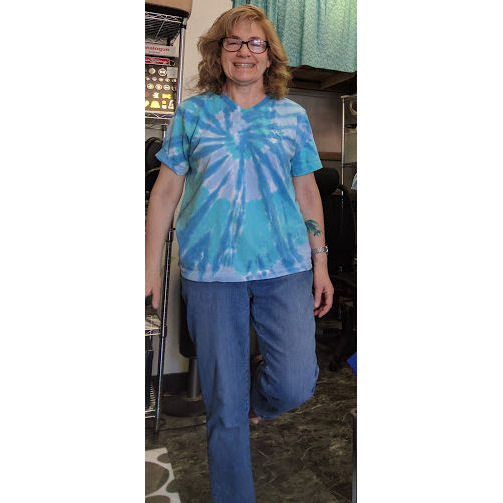
I should know. I do 2 minutes of balance exercises every day. Standing on one foot for a minute while I brush my teeth, and then the other one sometimes gets messy, but bathrooms wash. Some days I do more, but most days just those 2 minutes. And my balance has improved.
When you’re starting to develop a new habit, it’s hard to remember it some days. That’s why stacking the new one (a balance move) on an old one (brushing teeth) is so helpful. Pretty soon you don’t even have to think about the new one, and it just feels wrong if you miss it.
So, use that counter if you need it to stabilize yourself. Stand on one foot. Make sure your back is straight, your hips are level, and your core is tight. You’ve got a built-in ballet barre to help you with your balance moves. And if you don’t need to hold on, so much the better. Use your formerly wasted time – stop scrolling and start balancing. You’re not only improving your balance, you’re improving your resilience, too. Those who’ve fallen and not done anything about it are more likely to become isolated and withdrawn. But not us – we’re out there. Independent and able to do what we want, when we want.
I’ve got to admire Al Roker. He’s looking great these days, and this month he’s focusing on improving his balance while he walks. In the clip on the Today show, he merely said he wanted to improve his balance, so that’s the focus of their February challenge. Stephanie Mansour, the fitness consultant for Today, has put together a month-long challenge for members of the show’s “Start TODAY” 100-day challenge that will combine balance, walking and core work. The show’s website provides a calendar that indicates the kind of work to do on any given day – walk, balance or core.
We use balance in everyday movements
Mansour emphasizes the importance of balance in overall stability because we use it for things we don’t even think of every day – like getting up from a chair or picking something up off the floor. With better balance, we don’t even think of movements like this. But if our balance is weak, then, for example, we’d think twice about picking that piece of paper up. And it would take at least twice as long to brace ourselves to get out of a chair. Mansour includes core work in this challenge because strong core muscles lead to stronger balance. Our core helps our posture, our breathing, and our ability to move.
We know that balance is crucial for our healthy aging. Without our working to maintain it, our balance erodes over time. But, we can do something about it. Al Roker recognizes this. We can work to improve our balance with simple exercises. The “Your Week of Core-Centered Balance Moves” Guide gives you some of the exercises that will help.
Some Balance Moves
The recommended exercises highlighted in the Facebook group Balance for Fitness, Balance for Life, are just that – recommendations. They’re not the only ones that will help to improve your balance. Mansour highlights other, probably more advanced, balance exercises. She includes the yoga “Tree” pose, Plank Shoulder Taps, and “Warrior III.” The Plank Shoulder Taps combines core and balance, where you tap alternating shoulders while you’re in Plank position. Warrior III is another balance move that’s quite challenging. There’s also a move that Mansour calls the “Balance Beam Walk,” that’s like Inline Walking, but balancing a book on your head. Again, it combines balance, walking and core.
More Core Moves
Of course Mansour highlights “Plank” as a good core strengthener. Others exercises in the Today challenge include “Bird Dog” (raising opposite arm and leg, alternating) and “Dead Bug” (Lying on your back with arms stretched up and legs lifted, bent at a 90-degree angle. Touch the opposite knee with your hand and go back to the original position.).
Get into the balancing act! You’ll work everything – and combine balance, walking and core.
My balance group people are probably sick and tired of me telling them to “tighten your core.” But the core is the center of, pretty much, everything. Your core holds you up, helps you breathe, saves your back and saves you from falling. Strengthening your core also helps to improve your balance. Back to the core of it all – your core.
What is your core?
In a nutshell, your core includes all the stabilizing muscles in your middle – front and back. Your transverse abdominis is deepest and wraps around your middle like a girdle. It connects your rib cage to your pelvis and holds everything in place. Your internal and external obliques are next out toward the surface. These muscles criss-cross your middle and help with twisting and bending. Closest to the surface is the rectus abdominis – your six-pack – which also helps with bending and pelvic control. So, literally, your core really is the center of everything.
What will a strong core do for me?
You’re probably slumping in your chair. Straighten up! See that – you engaged your core! When you tighten your core, you’re able to sit or stand more upright. And when you’re upright, you can breathe more fully, get more oxygen into your lungs, and into your bloodstream.
Got a bad back?
I had back pain fairly regularly after a fall I took a few years ago. While I was healing I had time to do some research and found that improving your balance helps to prevent falls. My research also indicated that a strong core helps improve balance, and it also helps to prevent lower back pain. (This is from a study published in the Journal of Physical Therapy Science.) Core strength training helps alleviate low back pain. This is crucial for our healthy aging. Nothing ages us more than pain, and many older people complain of back pain.
Tighten your core for better quality of life
Imagine a life without back pain. A life with free breath and limitless movement. This is the potential you can have when you tighten your core.
How do you tighten your core? Suck it in. That’s easiest. Feel your stomach pull in. This is easiest when you’re lying on your back on the floor. Put your hand on your abdomen and tighten. Now stand up and do the same thing. Now, download your Week of Core-Centered Balance Moves and do an exercise a day. That’s a great start to strengthening your core.
I woke up yesterday and could not remember what day it was… The day before was unremarkable. I didn’t do anything out of the ordinary. And all the days are running together. But then I thought of something special I had planned for later in the day which lit a spark. (I planned to design a cover for my new fitness journal that’s in the works.) And suddenly the day filled with wonder. I did the 3 things to start my day positively, and the rest of the day was bright and happy and full of purpose.
It stands to reason – if your day starts well, it will progress the same way. So, let’s consider the start to the day. Everyone has morning rituals. Are yours positive? Do they inspire you to find light in your day?
Wake up
Paul Valery, a French poet and essayist, said “The best way to make your dreams come true is to wake up.” He recognized he wouldn’t get anything done by lying around in bed all day. You need to wake up and get moving to make things happen. So, start your day positively by actually getting out of bed when your alarm goes off rather than hitting the snooze button and turning over. I have it easy – if I don’t get up when my alarm goes off my dogs will step on me…
One positive thought
“Just one small positive thought in the morning can change your whole day.” The Dalai Lama knows a great deal about having the right mindset. To create positive energy which will follow you throughout the day, start with a positive thought from the moment you wake up. So even if you don’t have something special planned for the day, think of something positive and that will create positive energy for your day. You’ll grow your resilience with your optimism and create that uplifting mindset. Most days I choose happiness! Whatever else I have going on, happiness makes the day brighter.
Today is my future
“My future starts when I wake up every morning.” Jazz Musician, Miles Davis, realized the value of a fresh and positive start to every day. Embrace this attitude by reminding yourself from the moment you wake up just what you’re striving for and why this is important. Reach forward toward your goals. Davis also was famously frustrated by fellow musicians retreating – going backward rather than forward: “Instead of going forward he was going backwards. I told him not to lose what he brought from Chicago, but some guys just go backwards, man.” (about Darryl Jones, bassist)
Every day: wake up and stretch. Have a positive thought while brushing your teeth. And remember that today is your future: it’s going to be great!
Here’s something we can all agree on: no one is getting younger. It’s also a fact that women go through menopause at some time mid-life. The CDC has emphasized the importance of exercise for everyone, at every age. So, even though women’s bodies are changing, does that mean that our exercise should change? If we’re used to intense exercise, can we continue with that intensity? Or, if we need to start doing something, what’s the right intensity level? What’s the proper exercise intensity after menopause?
The short answer
Everyone is different. You know your own body, so do what feels right.You still should challenge yourself, but you might want to be creative about the challenge.
Former First Lady Michelle Obama is quite open about her menopause experience. If you recall, when she lived in the White House she famously led “fitness boot camps” for friends and came to be known as the “Drillmaster.” Everyone wanted Michelle Obama’s beautifully toned arms. Mrs. Obama still exercises, but she admits that she’s toned down the intensity. She has found that she cannot push herself as hard as she used to. Obama and her friends turn more to flexibility rather than cardio workouts. Not only that, Obama no longer leads all the workouts, but her group of friends keeps everyone fit and healthy.
The answer for me
As you know, if you’ve been reading my articles, I work out regularly. I’ve challenged myself and as a consequence can run faster now than I ever could before – because I committed to it. I still don’t enjoy it and probably never will, but that’s not why I run.
The answer for everyone
Listen to your body. If you’re feeling good, perhaps push yourself a little harder. If an exercise is especially tough, ease up. Perhaps focus a little more on lower intensity moves or work in an extra Yoga or Pilates program.
Watch the “slow weight creep”
Mrs. Obama admitted to the “slow weight creep” of menopause. As she wasn’t able to maintain the intensity, she wasn’t burning the calories that she used to. And so had to be mindful of her intake. “I have to be more mindful, not obsessive, but more mindful,” she said.
The Mayo Clinic agrees with Michelle Obama’s assessment: “Women tend to lose muscle mass and gain abdominal fat around menopause. Regular physical activity can help prevent weight gain.”
Now’s the time to improve your balance too
The Mayo Clinic also recommends working on your balance to improve stability and prevent falls. “Try simple exercises, such as standing on one leg while brushing your teeth. Activities such as tai chi also can be helpful.” Please note, though, that while tai chi improves balance over time, the improvement is cumulative. Tai Chi practice over a period of time will help your balance. The simple exercises found in the Week of Core-Centered Balance Moves can start helping you in just a couple of minutes a day.
Never stop
I’ve known many people who view retirement and aging as an excuse to quit their exercise programs. But, now is the time to get fit and strong and live our best lives – actually do the things we worked for, for all those years. Listen to your body. If you’re feeling good and things don’t hurt, your exercise intensity after menopause does not have to decrease. Take the time your body needs to recover, but don’t stop.
Being mentally tough, or “resilient,” is what all the psychology “experts” are talking about in the last couple of years. While it’s crucial to our well-being and healthy aging to be able to bounce back when the going gets tough, it’s also important to stay kind – what I call “compassionate resilience.”
Awareness
If you’re feeling panicked by events in the world, the first step is to be aware of that feeling, and then how you’re going to interact with those events. Is it panic? Or overwhelm? Are you frustrated? If you’re an observer, observe without judgment of yourself. If you’re a doer, figure out how you can make the situation better – first for yourself and then, perhaps, for others.
Be aware of how your feelings affect you. Identify them – is it fear or anxiety that you’re feeling? Why? How will the happenings far away affect you here and now? Or here and later. If you’re feeling overwhelmed, identifying the things that are causing that feeling will help you to start on unraveling the tangle of burdens that you feel pressing upon you. Nurse practitioner Deborah Stamm of the Center for Health and Integrative Medicine at Advocate Good Shepherd Hospital says that naming the emotion “lessens the intensity and reminds you that you are in control of the emotion, not the other way around. It keeps you connected with your logical brain, and you are better able to think of new ways to handle situations that arise.”
Action
Taking action will help you turn your narrative around.
If that outcome is not something we want, how can you change it? Changing the narrative from, “I’m scared” to “I’m going to write to my Congressperson” will make you feel that you’re accomplishing something worthwhile. You’re being mindful of the moment, you dispassionately thought about the situation and decided on a course of action. At the same time, though, be sure not to let yourself think too much about the future. Do what you can now and put the situation aside until something changes or something else can be done about it
Be grateful
Stamm says another crucial aspect of resilience is gratitude. She says our brains are wired for negativity but, in contrast, optimism leads to resilience. We have to work on our positivity, to balance our brains. See my article “Five Ways to Maintain Positivity” for a start. Stamm recommends writing in a gratitude journal for a start on triggering positivity every day.
Be kind to yourself
Finally, to boost your resilience, be kind to yourself. If others talk about you in negative terms, don’t believe them! It’s easy to be down on yourself. We all do it from time to time. “I’m too fat.” “I shouldn’t eat that chocolate.” “My hair is terrible.” It’s easy to get caught in that trap. But – don’t! Eliminate that negative self-talk! You are worthwhile. The things you do are amazing! Believe that.
Be grateful for the great things in your life. Believe that you’re worth every good thing that comes your way. Identify your feelings, especially the negative ones so that you can create a plan of action to turn your own narrative around. All this will lead you to compassionate resilience. You’ll be mentally tough – but still kind and compassionate.
What would you say if someone told you that you could live longer by doing something simple for two minutes a day? There’s a new study by the British Journal of Sports Medicine that indicates that we can live longer if we can balance on one foot for at least 10 seconds. Live longer with balance. Seems like a no-brainer.
Years balancing
I balance on one foot every day.
I’ve written for years about balance. My interview with Kathleen Cameron, Senior Director of the Center for Healthy Aging, part of the National Council on Aging (ncoa.org), about balance, falls, and health as we age was back in 2017. I learned about the importance of balance after a fall which injured my knees and triggered hip bursitis a few years ago. Balance in everyone deteriorates after 50, but as I’ve discovered, we can actually improve our balance. Most people don’t know that their balance gets worse over time until it’s too late, and they suffer a fall.
Longevity correlates to fitness level
According to the study, “the inability to balance on one foot is associated with an 84 percent higher risk of death over the next seven years.” The study indicates that those able to balance had less history of heart disease, high blood pressure, diabetes, high cholesterol and obesity. The study also contends that people who are able to balance on one foot for 10 seconds are stronger and more fit. Also, people who can balance might be more agile and move more than people who can’t balance.
Dr. Lakshpaul Chauhan, geriatric medicine physician at Aurora Sinai Medical Center, says that lack of physical activity can be linked to weakness and frailty. Dr Chauhan encourages seniors to take action now.
Healthy aging upward spiral
Instead of a downward spiral, the ability to balance may lead to an upward spiral: you can balance on one foot, so you want to test yourself and balance more.
This leads to wanting to go for walks with the dog or a partner. You can balance longer, so what else can you do?
Those walks may inspire you to do more for your fitness like learning to dance.
You’re feeling stronger so you pick up that set of weights that you saw on sale.
You have more energy from all that exercise so you get the ingredients to cook that meal that looked so good in the magazine you looked at.
And before you know it, you may have lost a couple of pounds, you’re sleeping better and are feeling great.
All of which leads to a longer, healthier life. Healthy aging knows no bounds.
I include some core exercises every time I work out. It’s not that I particularly enjoy them (I don’t). Or that they feel good (they don’t). But a strong core means that my back doesn’t hurt as much – or at all. And a strong core means that I’m less apt to fall. A strong core means a happier me. Consequently, this means that improving core strength is crucial for healthy aging.
A few years ago I fell on an uneven sidewalk, triggering incredibly painful hip bursitis and sciatica. I couldn’t move normally for weeks, and needed physical therapy to get back to some activities I enjoy. As a result, while I was sidelined, I researched ways to prevent falls. I discovered that falling is a common problem with the elderly – fully 25% of people over 65 in the US fall and require medical assistance. With a little more research, I discovered that having a strong core is the solution to many ailments that prevent seniors from living a full and active life.
What is the core?
Your core is much more than your abdominal muscles – your “6-pack.” Sure, your core includes that, as well as everything else in your torso and further down, including your hips, lower back and backside. Stabilizing your pelvis and spine, helping your body maintain posture as well as keeping us mobile are just a part of what your core is used for. 35 different muscles in your core “keep you upright and strong.”
Your core helps balance
You know that I emphasize balance. (Get your Week of Balance for tips on improving your balance.) Your core helps to keep you upright and stable, which maintains your balance. And your core will help you navigate uneven surfaces. If your core is too weak, you won’t have a chance of adjusting your pace or posture.
Your core helps your posture
I see many older people with rounded spines who walk with canes. I want to walk upright. My core helps with that – it includes all the muscles that wrap around my spine. If those muscles are strong, they can hold me upright, even when I’m sitting. If I’m upright, my head is held high and my self-confidence grows. Likewise, if I’m upright, I’m breathing better. Try this: sit in a chair, pull in your stomach and sit up straight. And breathe normally for 10 seconds. Now slump – the way you usually do – and breathe. Harder, isn’t it?
Strong core for a strong back
Ever have sciatica? It hurts. A lot. Shooting pain from your lower back down your leg. And how’s your lower back? When you get up from a chair do you hang onto your back because it’s so painful? Strengthening your core will help you back. Just sucking in your stomach (practice this – it may take you a little while to get the hang of it) when you’re standing up really helps too. Try it: when you’re sitting in a chair and are getting ready to stand up – even if you’re using the chair arms or a table to hang onto for support – suck in your stomach, plant your feet and push off. Better, right?
Everyday activities
So, your core holds you up and it helps you get up. It stands to reason that a strong core will help you in all your daily activities. Getting into and out of a car, walking around a grocery store, bending to put groceries in your car and take them out.
Strong core for healthy aging
Are you convinced that your core is the key to living a normal life without having to worry about falling? Without worrying about how to stand up from a chair? And without planning how to get in and out of your car? If I’m three rooms away and discover that I left my water glass in the kitchen – after I sat down, I just stand up and get it. Not thinking about how to do everyday things should not be a luxury. A strong core really does lead to life without limits.
How to get one
So – how do you strengthen your core? You’re convinced that you need a strong core, but don’t know how to start? Good news – crunches are not mandatory, and neither are planks. These are two very effective exercises for strengthening your core muscles, but they’re certainly not the only ones.
And if your doctor has told you that you should lose some weight – don’t wait to start strengthening your core. You do have muscles under there, so start working them.
Suck it in
Start with sitting in a chair and pulling in your stomach muscles. Hold it … for 15 seconds, release and do it again. And one more time.
Leg lift
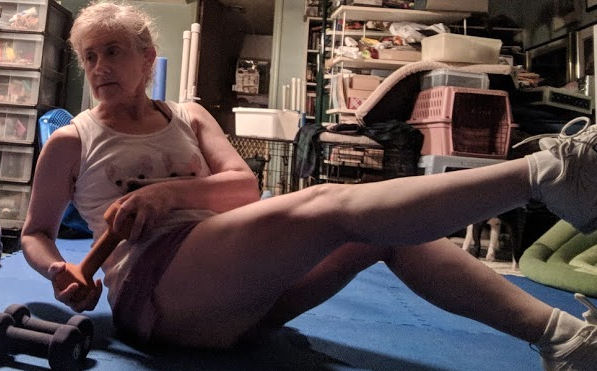
Still sitting, with your stomach pulled in and not holding on if you don’t have to, raise one leg with the knee bent. Moderate speed, then put it down carefully. And the other leg. 12 times.
If you can do this exercise with your leg straight, go for it.
Leg circle
Sitting or standing with your stomach sucked in, draw a half-circle on the floor with your toe, leg extended. If you’re standing, you can hang onto the back of a chair or the wall for balance. 8 each side.
Knee pull
Standing – you can hang onto the back of a chair or the wall for this – while your stomach is still sucked in, pull your knee up to your chest and put it down.
Balance exercises
All of the balance exercises in the Week of Balance utilize your core without your realizing it – take advantage of the benefits of these exercises.
That’s just a start – there are so many more core strengthening exercises. All to help your balance, posture, breathing, health. Get a strong core for your healthy aging.