Functional fitness moves – not just a trend

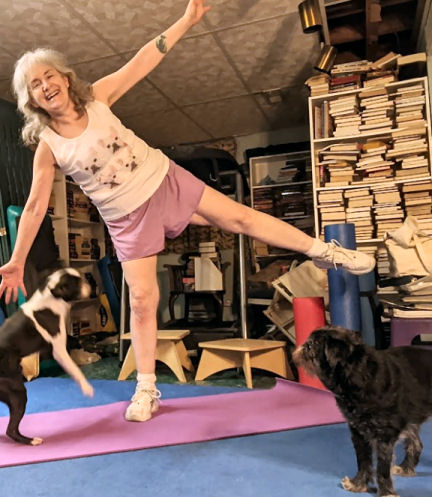
I don’t want to exercise just for the sake of exercising. Exercise is not my favorite thing to start with, so I’m only going to do it if it makes my life better in other ways. Focusing on functional fitness moves makes sense, then. “Functional fitness exercises train your muscles to help you do everyday activities safely and efficiently,” according to the Mayo Clinic. These exercises combine moves the way we move in everyday life. And, in fact, when we do functional moves, we’re getting at least double the benefit of the exercise. That’s efficiency. 

The workouts I do have incorporated funcional moves for years – I never knew it. That’s how a 30-minute functional workout can take the place of a 45-minute one that doesn’t employ functional moves. And, the moves frequently use weights, so we’re getting the strength training we need for our muscle and bone health. The moves involve multiple joints and multiple muscles in the same exercise. Employing functional exercises makes moving around doing everyday activities easier, which improves our quality of life, increases our independence, makes us more optimistic and more resilient.

One functional fitness move is the squat with an overhead press – hold a pair of weights that are challenging for you, bend your arms so the weight is at the same level as your shoulder and have your feet shoulder-width apart. Squat, bending your knees so that they’re behind your toes if you look over them. Stand up and press the weights overhead. Bring the weights back to the starting position and repeat. You’re working most muscles in your body with this one.

Another functional move is the deadlift with row. Stand tall, holding challenging weights, keeping your knees soft. Bend from the hips keeping the weights close to your legs. At your lowest point, bend your elbows and bring the weights up to your waist, keeping your arms close to your sides. Bring the weights back down and stand. Repeat. 

You get the idea – with functional fitness moves, you’re performing multiple moves, working more than one part and getting ready for whatever your day brings.

Train yourself to be happy

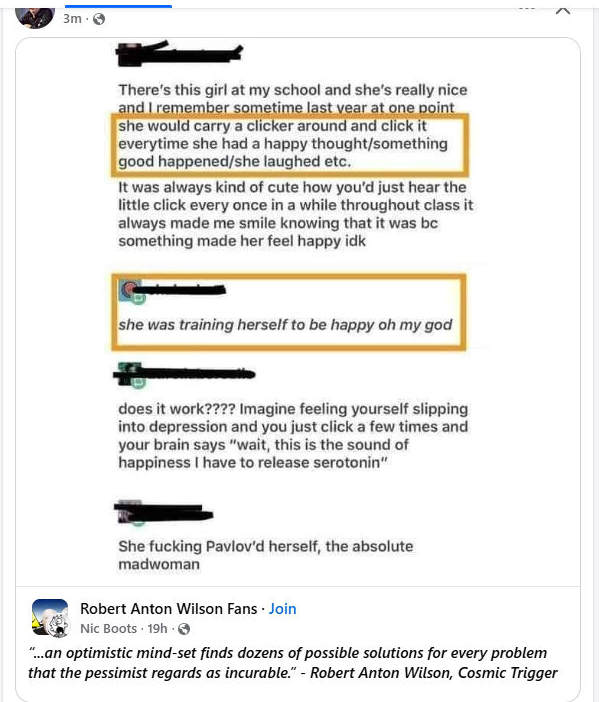
I check FB regularly throughout the day. I never know when I’ll get inspired (like for this article). Anyway, this showed up in my Facebook feed this morning, posted by an old-time SF curmudgeonly author I follow. The funny thing is, clicker training works. I train my dogs and use the clicker religiously to bridge the time gap between the dog’s correct behavior and the reward. And positive reinforcement is the most effective way to train dogs for lasting behaviors. But for people? Why not? In this case, the girl was training herself with the clicker to be happy when she heard the click. So, why not train yourself to be happy anytime?

Do you remember the TV sitcom The Big Bang Theory? There was an episode that stuck with me in which Sheldon trained his neighbor and roommate’s significant other, Penny, with chocolate to do things he wanted her to do. Positive reinforcement at work. Chocolate would work for me, but I’d have to watch the calories!

It goes back to Pavlov ringing that bell for the dog’s dinner. It got so that when the dog heard the bell, he started to salivate. 

Why wouldn’t this work for me? The clicker sound is too loud when I’m working in total quiet, so perhaps I’ll look for a bell tone in the app store. A nice quiet “ding.” When I see something I like, I’ll push the button for the ding. And at some point, just hearing the bell sound will make me happy. And, as we know, happiness promotes resilience and healthy aging. I vote for happy!

I looked up Robert Anton Wilson, the author whose fan group originated the post. He promoted the idea that we question everything. That each of us exists in a “reality tunnel” constructed by our own conditioning, beliefs, and sensory experience. Therefore, if we change our beliefs, we can change our reality.

Following the thread, if we change our beliefs, that we zero in on the sound that clicker or bell makes, we change our existence to happiness. And, therefore, train yourself to be happy anytime.

Tips for focus

I never understood kids who studied with music on. When doing homework for school, I was always distracted by the tunes. I’d want to sing along or get up and dance. I needed silence. But now, I have tinnitus, which is annoying and distracting by itself. And focusing is very difficult for me. I try listening to music, both with and without lyrics, but, again, distracting. And I have tried white noise, pink noise, brown noise, which is better but still distracting. I’ve gotten great tips for focus, which I have shared and will again, and they do help somewhat. But the noise is still a problem – both the kind of noise I try and the lack of noise. I recently learned about a new kind of productivity app that combines sounds which has helped students with ADHD and autism..

Screens down

The first focus tip, and key for those wanting to focus, is to put the screens away. Except, of course, for the screen you’re working on. I write in Google Docs, both on a PC and on my phone. So having that screen open is mandatory. Everything else goes away until I’m done.

Dogs Away

Keeping others quiet. My dogs are annoying. There. I said it. When they’re around, they’re cute and all, but it’s impossible to focus when they want to play. So, when I know I have to spend quality time on a project, I make sure to take them out and get them settled before I start. Same thing with kids or other adults. Give kids treats and plant them with books, coloring material, or another way to keep them occupied for the duration. And let the adults know that you want to concentrate for an hour or so and don’t want to be disturbed.

Clear the work area

Clear the decks. The next tip for focus is to have a clear work area. My desk is constantly messy, so I push things to the side while I do the work that requires attention.

The new productivity app that I referred to actually combines white noise with instrumental music. You play around and figure out what’s best for you. Every brain is different, so it’s customizable. I’ll have to try that and see if it deserves to be added to the list of tips for focus.

It’s easier than ever to be together

It’s commonly held that a risk for older Americans is the feeling of being excluded and isolated. It’s a danger that the National Institutes of Health addressed recently in a study. The study compared this feeling of isolation in seniors compared to younger adults. And it surprisingly found that most older adults actually know when they’re being excuded but respond to the exclusion somewhat more rationally than younger adults. 

Older people recognized the exclusion

In fact, more older adults were able to recognize the exclusion but their self-esteem was higher and recognized the exclusion in the study as insignificant. They were able to analyze the moment and move on to what they felt were more important pastimes. Older people also usually have better emotional regulation. We’re better able to control our emotions when things go a little off-kilter.

As older adults, we’re not caught in the school-yard culture of insiders and outsiders. In school, there’s always a clique of popular kids that all the other kids feel compelled to emulate. And there’s always a group of outsiders. We never wanted to be in the outsider group. But as older adults, we’re removed from that clique culture.

We grow our community

This is important in many respects. One of the basic tenets to improve our resilience is to grow our community. When we interact with others, our own sense of self-worth grows, as does our resilience. A danger for many seniors is loneliness and loss of that community. As we found out a few years ago during the pandemic, it’s much easier now to be together and grow our circle, though, and many seniors are doing just that with online groups. 

The study found that younger people were more likely to see the exclusion as a negative experience. But older folks took this particular isolation in stride. Perhaps because the study participants had other circles they rely on.

Community is key

Americans are taught to deal with hardship through introspection and careful examination of our thoughts, feelings, and behavior. But Psychiatrist Dr. Suzan Strong, in her new book Why We Suffer and How We Heal, reveals that some cultures deal with hardship and instability through community, which makes it easier to be together.

So, what does this mean for us older Americans? Keep growing our resilience. Keep growing our circles of friends, acquaintances, and those with common interests. Be together with them. We’re doing it right.