Be active without back pain

We all strive for healthy aging, and that includes a healthy back. But so many of us are plagued with back pain as we get older. At the grocery store I see people who I think are about my age hunched over their cart and taking very slow steps, possibly because they’re in so much pain. And I see heartbreaking posts from friends on social media who are forced to cancel fun plans because of their back pain. For me, back pain comes and goes – and fortunately it’s mostly gone these days. So, how can we be active without back pain?

Bend the right way

We all know to not use our backs when we lift heavy objects. Bend your knees, squat and pick it up. Use the strength in your thighs, not your back. Keep your back straight when you lift. And when something is absolutely too heavy to lift, ask for help. I know that’s hard…

Suck it in!
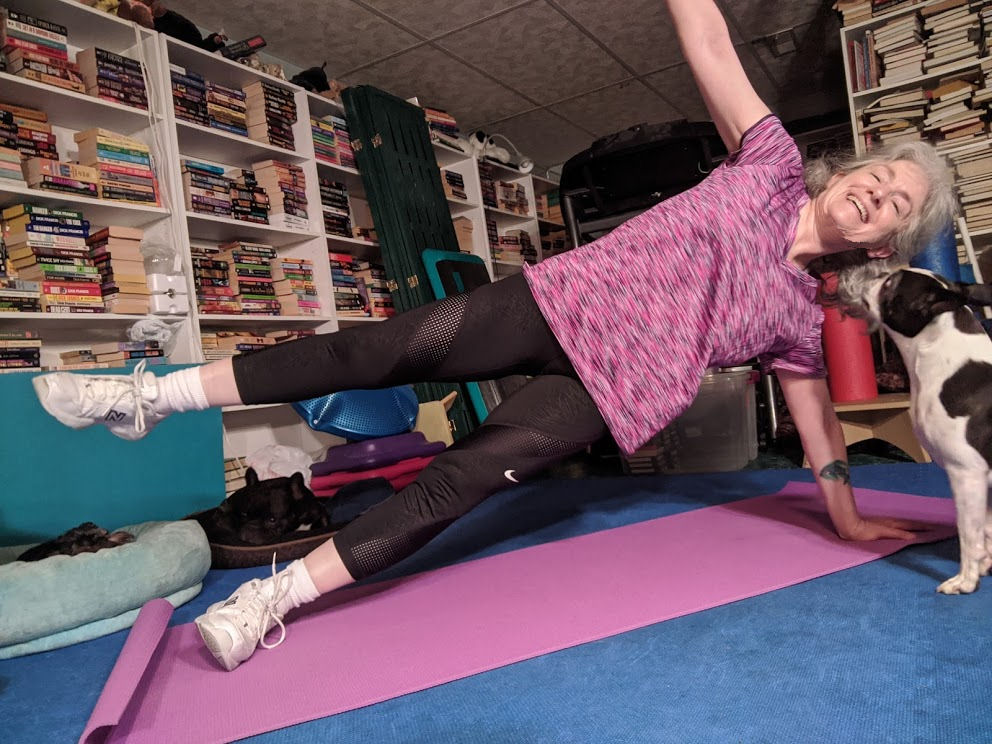
Healthy aging involves a strong core. And that helps you to Be active without back pain.
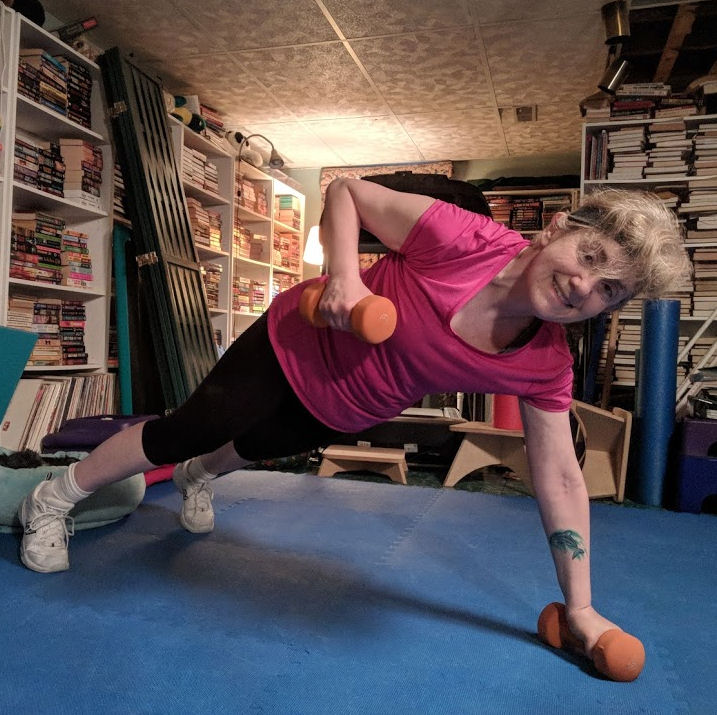
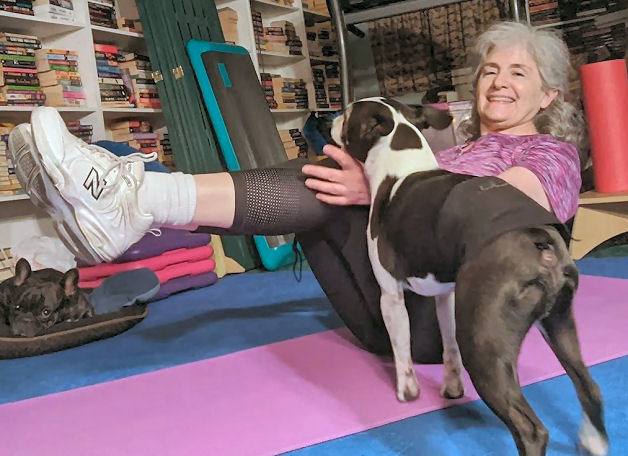
The side plank – yet another plank variation – helps you get a strong core so you can be active without back pain.

I’ve been saying to tighten your core quite a bit these days. But, it’s the safest way to carry something. And when you’re straightening up from a squat or a crouch, suck it in. It really helps. Having a strong core leads to a strong back! I’ve been making an effort to focus more on my core for the last couple of years and have (knock on wood!) experienced hardly any back pain lately. I used to be the poster child for having a heating pad on my lower back. And that would be real torture this summer with the heat and humidity we’ve had. My hip bursitis would combine with sciatica in years past and it was so painful that I could hardly move. 

Equalize the load

If you carry a heavy shoulder bag, you could be contributing to your back pain. Switch sides every once in a while, or use a backpack. (I’ve tried to carry my bag on my right shoulder but it just feels wrong.)

Healthy mind leads to a healthy back

The experts at Advocate Aurora Health say that a healthy mind also leads to a healthy back. When people with an optimistic outlook get back pain, they tend to feel better sooner. “A positive mental attitude can help in handling back pain so that you bounce back fast and don’t let it turn into a chronic condition. Meditation can reduce stress and muscle tightness.” While it may not seem possible to achieve a positive outlook when you have back pain, there are things you can do to become more optimistic. And even a short guided meditation (like the “Garden Walk Guided Meditation” that you can download) will help reduce stress.

A healthy back for healthy aging

Living life pain-free is certainly the goal for those of us over 50. And while most people under 50 probably don’t think of back pain, they should probably pay attention to ways to maintain a healthy back too. Just keep a few things in mind: suck it in, and be careful how you lift and carry things.
Lift weights at my age?

There are loads of fitness myths and misinformation out there. Things you read about that sound like they might be true. Like if you, as a woman over 50, lift heavy weights, you’ll still get bulky and misshapen like a bodybuilder, so it makes sense to lift lighter weights and do more repetitions.

The fact is that, no matter what age you are, if you’re a woman, lifting heavy weights will not bulk up your muscles. Kristen Turner, a health navigator with Advocate Lutheran General Hospital, says, “Women do not gain muscle mass the same way men do, nor will they “bulk up” through training with challenging heavier weights.” In fact, the Centers for Disease Control recommends that everyone 65 and older include 2 days a week of weight training for their healthy aging. So, yes, I do lift weights at my age (and I’m 67)!

The truth about weightlifting

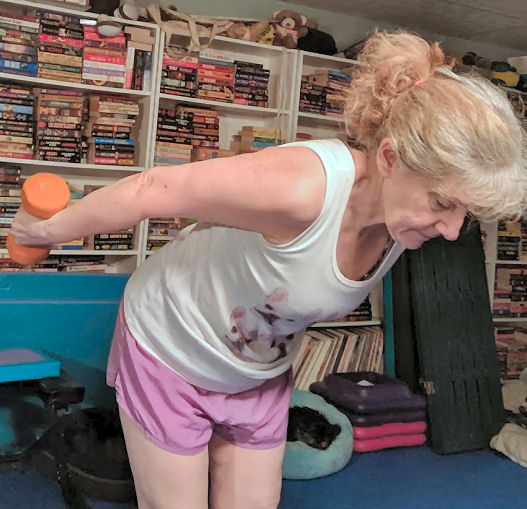
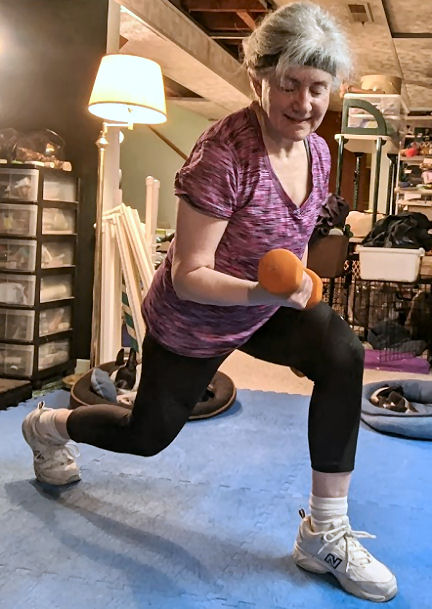
Yes, I do lift weights at my age! Here's a biceps curl.
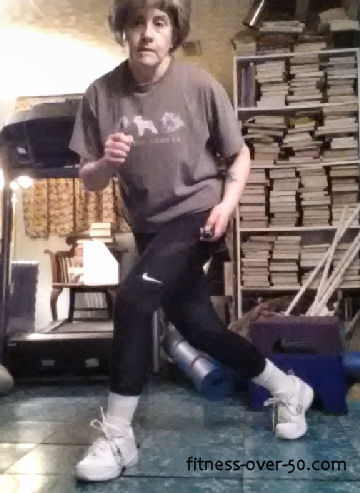
Biceps curl with a lunge!

Your strength workout doesn’t have to take forever. In fact, Turner suggests just 8-12 repetitions, 8-10 exercises, that focus on all major muscle groups. The weights you use should be challenging, but not impossible. They shouldn’t be too light, either. Your twice-a-week strength workout will give you improved tone, strength and will help in weight management. The more muscle you have, the more calories and fat you will burn, giving you an overall toned physique. And I’ve found that with strength training comes more stamina. Gravity is evil, but we’re all subject to it. Our strong muscles will help carry us wherever we want to go.

Do I need free weights

You can get a great strength workout using just your own body weight. The plank pose, and all of its variations, will work virtually every muscle in your body. And all you need is the floor. As I mentioned in a previous article, if you can’t do the full plank at first, there’s always a modification. The plank pose works your arms, your shoulders, your core, and your legs.

If you want to go the free weight route at home, like I do, I did a little searching online for prices. These days you can get a pair of 3-, 5- and 8-pound weights and a stand for them for less than $100. These are certainly heavy enough for you to get started, and probably for quite a while after that.

What I do

I work out 4 – 5 days a week. 2 days I run / walk for 20 minutes on the treadmill and do 10 minutes of core work after the run. 1 day a week I do a Pilates routine (30 minutes) with a resistance band, which makes it more challenging. And 2 days a week I do combined aerobics and free weights, 30 – 40 minutes. Yes, I do lift weights at my age!

Get strong for your healthy aging

Don’t be scared of strength training. Lift weights – or at least heavy tomato cans – for your healthy aging.

Turn your rough day around

Lately it seems I’ve been having a series of rough days. Days when hardly anything goes right. I’ve learned that you can’t change the outside world, so when important banking software crashes, you really can’t do anything about it. When it’s pouring and you have to make 5 stops after work, put your raincoat on. What you can change, though, is your mindset to turn your rough day around.

Change what you can for the positive

The first thing is to figure out if you can change anything that you previously thought you couldn’t. Can you postpone any of your errands to a day when it’s not raining? If your banking task is crucial, can you do it in person? If you can’t change things, give a mental sigh, take a deep breath and say to yourself, “Oh well. I’d better get changed, then.” If it were me having to run errands on a sopping wet day, I’d reward myself with a refreshing beverage. 

Change your immediate mindset

If, when you get home, things are still so rough that you’re having a hard time concentrating, it may be time to close your eyes for a few minutes and clear your mind. Listen to a short guided meditation or just let your brain clear out. This is what Dr. Donna Williams, a family medicine physician at Advocate South Suburban Hospital, recommends. Or if you’re feeling antsy, take a brief walk.

More long-term change for your mindset

Exercise - and my dog - turn my rough day around. Releasing endorphins and a dose of instant happiness.
Exercise – and my dog – turn my rough day around.

When I go to bed in a bad mood, I have trouble sleeping, so I try to change my mood before bedtime. Most days I exercise in the late afternoon which makes me feel more positive about my world. Dr. Kiran Bojedla, a family medicine physician at Advocate Christ Medical Center, agrees. “On days I feel tired or overworked, I often find the endorphin release from a run or short workout made my day better. It doesn’t have to be much – even a short 20-minute walk around your neighborhood can give you a feeling of accomplishment and boost your mood.”

On days when I don’t feel like exercising (most days), but do it anyway, I feel completely virtuous after a workout and the world certainly looks better. And that endorphin release that Dr. Bojedla mentions lasts for hours.

You’ll increase your resilience too

Consciously improving your mindset will make you happier. Happiness increases optimism, which increases your resilience. Improve your mindset, get happy and more resilient. You know that there will be tough days in the future. It happens that way for everyone. With increased resilience you’ll be able to face those tough days with more equanimity.

A strong core leads to life without limits

Get a strong core for healthy aging.

I include some core exercises every time I work out. It’s not that I particularly enjoy them (I don’t). Or that they feel good (they don’t). But a strong core means that my back doesn’t hurt as much – or at all. And a strong core means that I’m less apt to fall. A strong core means a happier me. Consequently, this means that improving core strength is crucial for healthy aging.

A few years ago I fell on an uneven sidewalk, triggering incredibly painful hip bursitis and sciatica. I couldn’t move normally for weeks, and needed physical therapy to get back to some activities I enjoy. As a result, while I was sidelined, I researched ways to prevent falls. I discovered that falling is a common problem with the elderly – fully 25% of people over 65 in the US fall and require medical assistance. With a little more research, I discovered that having a strong core is the solution to many ailments that prevent seniors from living a full and active life.

What is the core?

Your core is much more than your abdominal muscles – your “6-pack.” Sure, your core includes that, as well as everything else in your torso and further down, including your hips, lower back and backside. Stabilizing your pelvis and spine, helping your body maintain posture as well as keeping us mobile are just a part of what your core is used for. 35 different muscles in your core “keep you upright and strong.”

Your core helps balance

You know that I emphasize balance. (Get your Week of Balance for tips on improving your balance.) Your core helps to keep you upright and stable, which maintains your balance. And your core will help you navigate uneven surfaces. If your core is too weak, you won’t have a chance of adjusting your pace or posture.

Your core helps your posture

I see many older people with rounded spines who walk with canes. I want to walk upright. My core helps with that – it includes all the muscles that wrap around my spine. If those muscles are strong, they can hold me upright, even when I’m sitting. If I’m upright, my head is held high and my self-confidence grows. Likewise, if I’m upright, I’m breathing better. Try this: sit in a chair, pull in your stomach and sit up straight. And breathe normally for 10 seconds. Now slump – the way you usually do – and breathe. Harder, isn’t it?

Strong core for a strong back

Ever have sciatica? It hurts. A lot. Shooting pain from your lower back down your leg. And how’s your lower back? When you get up from a chair do you hang onto your back because it’s so painful? Strengthening your core will help you back. Just sucking in your stomach (practice this – it may take you a little while to get the hang of it) when you’re standing up really helps too. Try it: when you’re sitting in a chair and are getting ready to stand up – even if you’re using the chair arms or a table to hang onto for support – suck in your stomach, plant your feet and push off. Better, right?

Everyday activities

So, your core holds you up and it helps you get up. It stands to reason that a strong core will help you in all your daily activities. Getting into and out of a car, walking around a grocery store, bending to put groceries in your car and take them out. 

Strong core for healthy aging

Are you convinced that your core is the key to living a normal life without having to worry about falling? Without worrying about how to stand up from a chair? And without planning how to get in and out of your car? If I’m three rooms away and discover that I left my water glass in the kitchen – after I sat down, I just stand up and get it. Not thinking about how to do everyday things should not be a luxury. A strong core really does lead to life without limits. 

How to get one

So – how do you strengthen your core? You’re convinced that you need a strong core, but don’t know how to start? Good news – crunches are not mandatory, and neither are planks. These are two very effective exercises for strengthening your core muscles, but they’re certainly not the only ones. 

And if your doctor has told you that you should lose some weight – don’t wait to start strengthening your core. You do have muscles under there, so start working them.

Suck it in

Start with sitting in a chair and pulling in your stomach muscles. Hold it … for 15 seconds, release and do it again. And one more time.

Leg lift

Still sitting, with your stomach pulled in and not holding on if you don’t have to, raise one leg with the knee bent. Moderate speed, then put it down carefully. And the other leg. 12 times. 

If you can do this exercise with your leg straight, go for it.

Leg circle

Sitting or standing with your stomach sucked in, draw a half-circle on the floor with your toe, leg extended. If you’re standing, you can hang onto the back of a chair or the wall for balance. 8 each side.

Knee pull

Standing – you can hang onto the back of a chair or the wall for this – while your stomach is still sucked in, pull your knee up to your chest and put it down.

Balance exercises

All of the balance exercises in the Week of Balance utilize your core without your realizing it – take advantage of the benefits of these exercises.

That’s just a start – there are so many more core strengthening exercises. All to help your balance, posture, breathing, health. Get a strong core for your healthy aging.

How to motivate yourself to exercise

You know you should exercise (for your healthy aging if no other reason) but can’t find your motivation. You’ve changed into your workout clothes and everything, but you’re still not feeling inspired. Sound familiar? You’re getting frustrated because you feel like you should know what to do, but just can’t get to it. Or you’re at the gym and are bored just looking at the row of treadmills. You’re at that motivation crossroads. You can exercise and feel great – improve your mindset and increase your endorphins, or not exercise and feel guilty that you didn’t. Here’s how to motivate yourself to exercise.

Are you bored with the prospect?

Motivate yourself to exercise with different moves.

Business motivation expert Art Markman, PhD, professor of psychology and marketing at the University of Texas, has identified three reasons you may be procrastinating. The first may be that you fear boredom. Like dreading that time on the treadmill because you’re afraid you’ll be bored out of your mind. I dislike running too, but get on that treadmill twice a week like clockwork.

Dr. Markman advocates a little distraction when you’re tackling boring tasks. I plug in my earphones and listen to an audiobook. Not a business book, but one with lots of action to take my mind off the running. Not even a steamy romance would help you motivate yourself to exercise. Nope – it’s got to have lots of action! That keeps my legs pumping.

Or do you think exercise is too difficult?

The second reason Dr. Markman says we might be procrastinating is because we could dread dealing with complex tasks. Exercise does not have to be complex. In fact, exercise should be the  easiest thing in the world so that we will do it. If an exercise is too difficult – like a complex step pattern, for instance, practice it again so that you can do it without stumbling. Or find a different workout that’s not as complex. At a gym, for an in-person class, ask your instructor if she teaches a more basic class.

When you’re working out at home, try a modification for the complex exercise. If you’re not strong enough, you’ll get there. When choreography is hard, rewind and practice the sequence again. You’ll get there. If the music is good, and you like the instructor, you’ll motivate yourself to exercise. As I always say, “There’s always a modification.”

Or perhaps you don’t know where to start?

The third reason your motivation to exercise may be lacking is because you don’t know where to start, or you feel that it’s beyond you. Know this: there’s an exercise for everyone. If you can move any part of your body, you can exercise it. As a beginner, suffering from chronic conditions, or recovering from an injury, if you can’t be on your feet for an extended period, there are chair exercises. If you can’t run, then walk, as I said earlier. Do arm circles if you can raise your arms. 

So, you can move and walk and even run – but if you don’t know what to do, do what you feel like doing. Like to dance? Put some music on. If you want something more structured, take a half hour and search YouTube for “beginner strength exercises for seniors,” as an example. I do a combination of aerobics and strength, which mixes moves up nicely. Search for that if it sounds appealing. As you’re doing your search, note down the instructors and programs that look interesting. 

Then, make a date with yourself a few times a week and go exercise. Look forward to that date as a way to figure out how you want to work out for the next few weeks. Keep that date. And reassess. Did you enjoy the workout? Did you wish it was longer? Shorter? Harder? Did you like the instructor’s style? If you look forward to spending time with your favorite exercise instructor, or if you like the music used, it will be easier to motivate yourself to exercise.

Exercise helps depression

We’ve all experienced depressive episodes – perhaps too many in the last couple of years. It’s natural to feel sad or depressed when we hear about all the horrible things going on in the world, and some of these hit us harder than others. In fact, “according to the National Institutes of Health, 17.3 million adults in the U.S. have experienced a depressive episode in the last year.” Major depression is considered a mental disorder, but minor depression, like what we feel on occasion, can even affect how our bodies respond. But all the experts agree that exercise can help depression.

How depression can affect us

At first depression can affect our focus and memory, and can even interfere with our sleep. Depression can cause headaches. And if our depression continues untreated, it can interfere with our ability to fight off disease. 

Happy people don’t catch as many colds.

 A study by a Carnegie Mellon psychologist found that “people who are happy, lively, calm or exhibit other positive emotions are less likely to become ill when they are exposed to a cold virus than those who report few of these emotions.” And when these happy people did catch a cold, they complained of fewer symptoms.

How to fight off depression

I'm always happier after I exercise than before. Exercise helps depression.
I’m always happier after I exercise than before.

So, we see that it’s beneficial to be happy – I don’t like being sick, and if I can fight off illness, I’m all for it. Keeping in mind that those with severe depression should seek professional help for it, those of us who have mild depression can improve their mood while improving their mental health, according to Dr. Munther Barakat, a psychologist at Aurora Psychiatric Hospital. Number one on Dr. Barakat’s list of ways to improve your mood and your mindset is to get physical exercise. “Exercise is a natural treatment for depression, and in some cases, is as effective as anti-depressant medication.”

Feel good about exercising

When I’m feeling down, I keep my date with myself and exercise. Inevitably, I feel better afterward. It’s not just running that produces endorphins, it’s exercise in general. Sometimes I just put my favorite tunes on and dance! Exercise helps depression. So, go ahead – turn on that music and move!

How do a mental block and exercise link?

A mental block can stop exercise

How does a mental block stop you from exercising?
You want to exercise but that mental block gets in the way.

Is a mental block the thing that’s stopping you from exercising? You know that you need to exercise for your healthy aging. And you have every intention of starting an exercise program. You’ve made a mental note of the exercises you want to do, or the workout video you want to try, but something keeps getting in the way. Every day. For two weeks. Your mindset just isn’t right, and you can’t figure out why it’s so hard. But how does a mental block and exercise link up?

You may even have changed into your exercise clothes, laced up your sneakers, but then you find something else to do. And then it’s time to start dinner. Or get ready for an appointment. And the opportunity to exercise is lost.

How does a mental block happen?

“When talking specifically about exercising — mental blocks are often associated with a lack of motivation that is in turn associated with a lack of vision,” says Dr. Munther Barakat, director of Behavioral Health Therapy at Aurora Psychiatric Hospital, Wauwatosa, WI. “The vision of what it means to exercise and how you measure success has to be clear. This makes it naturally reinforcing.”

Dr. Barakat seems to mean that deep down, you really don’t want to exercise. And I get that. I really, really dislike the act of exercising. I don’t like being sweaty or breathing hard. And when my muscles are shaky, like at the end of an intense aerobic workout, it almost feels like something is wrong. But I work out. I exercise. I push play on my DVD player, cueing up a workout video four or five times a week. Even though I don’t like to do it.

Because I do like the results. I like being able to do things I want to do, when I want to do them – without waiting for help. I like being able to walk anywhere I want. I like being able to train my dogs every day.

Your “measure of success” may be different than mine. And that’s great. Your next step, then, is to picture yourself on the way to that success. Formulate your goals and a path to get there. (I’ve written about goals, how to make them, and how to follow through, before.)

Other causes of mental blocks

Experts at the Sage Neuroscience Center say that another cause of mental blocks can include anxiety. I’ve felt this, certainly. If you’re anxious about something that’s going on in the world – either close to you or on the other side of the globe – this can cause massive indecision. Anxiety can paralyze you into indecision, making it impossible for you to actually do anything.

Another cause can be decision fatigue. You’ve had to make a lot of decisions lately, and making one more – like which exercise program to do – is just one too many. So you don’t make any decision. 

Remedies for an exercise mental block

Again, one solution can be to decide on a goal – like exercise four days this week for a half hour, walking and doing a workout video on alternating days. Schedule those workouts for the week. Keep to your calendar – when your exercise appointment comes up, keep that appointment! And on Sunday, schedule next week’s workouts.

If you want to go a bit deeper, get out your journal and write down the things you think are keeping you from exercising. Write down the things you’re anxious about. Sometimes the act of writing helps your brain to process, and helps you think of a solution to your blocks.

No limit to the benefits of exercise

The benefits of exercise are many.
Lifting those weights keeps my bones and muscles strong.

It’s no secret that I exercise multiple times a week. I exercise mostly so that I can do the things I really want to do. Like walk around a store (or a theme park) and run Agility with my dog. But there is no limit to the benefits of exercise in other areas of my life. Like mental clarity. More benefits are sleeping better, and keeping my bones and muscles strong. 

Benefits of exercise to the heart

And the benefits to the heart from exercise have been proven to be limitless. A recent study from the University of Oxford with 90,000 participants showed that the risk of cardiovascular disease was lower in those who were the most active. Five years after the study participants were still benefiting from exercise. 

Daily exercise is crucial for cardiovascular health, blood pressure control, weight loss and overall physical fitness. The researchers also determined that those who exercised had the healthiest BMI (body mass index), were least likely to smoke, and had lower alcohol intake. That’s not surprising. What was surprising, though, was that there was no limit to the cardiovascular benefit the participants received from exercising. “Results showed both moderate and vigorous physical activity drove down instances of cardiovascular disease.”  So – keep exercising and your heart keeps getting the benefits.

Not easy to maintain the level of exercise

It’s not easy to maintain a moderate or vigorous level of exercise a few times a week, though. Just knowing the benefits of exercise is not enough to make you put on your sneakers. Just like with New Year’s resolutions: many people are fired up at the start of the year to “get fit,” and their motivation may last for a few weeks, but they lose interest after a while. They may know the benefits of working out – that’s why they start an exercise in the first place, but that’s not enough to keep them going.

Know your “why”So, as I’ve said before – know your motivator. There must be something that compels you to get on the stationary bike, or climb those stairs, or get on the mat a few times a week besides the benefits to your heart. This is especially important for healthy aging. Know what motivates you, so that you can keep exercising and reap those benefits.

Figure this out before you work out

So you’ve been told you should exercise. It’s not just me who’s telling you that… It’s the Mayo Clinic – did you know that you’ll sleep better if you exercise? And Harvard Medical School – did you know that exercise can help prevent cancer? And yet so many people tend to avoid exercise. It’s easy to not exercise if, for example, your parents were not especially active. And it’s easy to keep on watching TV or reading when a show or book is engrossing. So, what will get you out of the chair? Before you work out, you have to figure out your motivator.

Figure out your motivator

In order to keep on exercising – because exercise is not a “one and done” thing – you have to have a really good reason to keep coming back to it. You’re not going to keep on exercising several days a week if you hadn’t been exercising before, unless you have a particularly strong reason to do it. Because, let’s face it, exercise is not the most fun thing on the planet.

I hate to exercise

A great workout eliminates stress.
I do not like getting sweaty… And yet…

I’ve said it before, I do not like to exercise. Not one little bit. And yet, I’m on my exercise mat or on the treadmill 4 or 5 days every single week. Even after all the years that I’ve been exercising, I despise it. The best part of exercising to me is when I’m done for the day. I do not like getting sweaty and out of breath. And the promise of fighting off cancer or getting better sleep are not good enough reasons to work out. So why do I do it?

My 3 big reasons

  1. I get to eat what I like
  2. I’ll be in shape to run my dog in agility
  3. I’ll be more able to face life’s challenges. I’m a big scaredy-cat. I figure if I have the discipline to do what I don’t like to do, I’ll be better able to face anything life throws at me.

What will make you lace up those sneakers day after day?

Those are my reasons. Everyone does different things for different reasons. The prospect of 7 or 8 uninterrupted hours of sleep might very well be your big motivator.

Or playing with the grandkids in the backyard. Or even having a backyard with a beautiful garden is your reason. Last week’s article was about how gardening can relieve stress. But in order to have a garden you have to do the work. Are you able to dig your garden, to kneel down and get those weeds? Perhaps you’ve figured out your motivator and that garden is it.

The key to getting the benefits of exercise is consistency. You have to keep on exercising to get anything out of it. So, you have to think about what will make you lace up your sneakers and get on that exercise mat. You have to figure out your motivator that will keep you working out six months from now, a year from now, for your best life.

Exercise can save you money

Exercise can help you save money.

You’ll be happier if you exercise.

And you’ll attract people to you if you’re not scowling – you’ll make more friends.

Exercise can save you money

Don’t believe me? A HealthPartners Research Foundation research study showed that people over 50 years old who started exercising only 90 minutes per week saved about $2,200 per year in medical costs. And a CDC study showed that older people who visited a health club twice a week saved over $1,200 more in healthcare costs than those who visited a health club less than that.

Sounds good to me.

How this makes sense

Exercise does more for you than just increase physical fitness. Exercise can save you money.

And it makes sense. If you’re exercising, you’re getting fitter. And you’re getting healthier. We’ve talked many times about the health benefits of exercising – It can lower your blood pressure and boost your good cholesterol (HDL). Exercise promotes better blood flow, and decreases the risk of heart disease. Plus, it can help prevent or manage other health concerns like diabetes and stroke.

Exercise has also been proven to ward off many types of cancer. Anecdotally, it’s been a long time since I’ve had a cold. Even before we all started to wear masks all the time, it had been several years since I’ve been laid low by illness (knock on wood – don’t want to jinx myself…).

Happiness after exercise

Exercise is also a mood-lifter. Those post-exercise endorphins are no myth. After a workout I’m happier and easier to be around. Just ask my sister. Exercise helps you sleep better too. And a good night’s sleep is a must-have for happiness. The world seems brighter after I burn a few hundred calories! And after a good workout there’s no guilt at eating a healthy dinner. 

Exercise can save you money and attract people to you!

If you’re happier and in a good mood, you’ll be easier to be around. No scowls – more friends. People will want to be closer to you. Even with a mask on, people know if you’re scowling! More friends = more happiness. A better outlook on life. And all from a couple hours of exercise.