How to motivate yourself to exercise

You know you should exercise (for your healthy aging if no other reason) but can’t find your motivation. You’ve changed into your workout clothes and everything, but you’re still not feeling inspired. Sound familiar? You’re getting frustrated because you feel like you should know what to do, but just can’t get to it. Or you’re at the gym and are bored just looking at the row of treadmills. You’re at that motivation crossroads. You can exercise and feel great – improve your mindset and increase your endorphins, or not exercise and feel guilty that you didn’t. Here’s how to motivate yourself to exercise.

Are you bored with the prospect?

Motivate yourself to exercise with different moves.

Business motivation expert Art Markman, PhD, professor of psychology and marketing at the University of Texas, has identified three reasons you may be procrastinating. The first may be that you fear boredom. Like dreading that time on the treadmill because you’re afraid you’ll be bored out of your mind. I dislike running too, but get on that treadmill twice a week like clockwork.

Dr. Markman advocates a little distraction when you’re tackling boring tasks. I plug in my earphones and listen to an audiobook. Not a business book, but one with lots of action to take my mind off the running. Not even a steamy romance would help you motivate yourself to exercise. Nope – it’s got to have lots of action! That keeps my legs pumping.

Or do you think exercise is too difficult?

The second reason Dr. Markman says we might be procrastinating is because we could dread dealing with complex tasks. Exercise does not have to be complex. In fact, exercise should be the  easiest thing in the world so that we will do it. If an exercise is too difficult – like a complex step pattern, for instance, practice it again so that you can do it without stumbling. Or find a different workout that’s not as complex. At a gym, for an in-person class, ask your instructor if she teaches a more basic class.

When you’re working out at home, try a modification for the complex exercise. If you’re not strong enough, you’ll get there. When choreography is hard, rewind and practice the sequence again. You’ll get there. If the music is good, and you like the instructor, you’ll motivate yourself to exercise. As I always say, “There’s always a modification.”

Or perhaps you don’t know where to start?

The third reason your motivation to exercise may be lacking is because you don’t know where to start, or you feel that it’s beyond you. Know this: there’s an exercise for everyone. If you can move any part of your body, you can exercise it. As a beginner, suffering from chronic conditions, or recovering from an injury, if you can’t be on your feet for an extended period, there are chair exercises. If you can’t run, then walk, as I said earlier. Do arm circles if you can raise your arms. 

So, you can move and walk and even run – but if you don’t know what to do, do what you feel like doing. Like to dance? Put some music on. If you want something more structured, take a half hour and search YouTube for “beginner strength exercises for seniors,” as an example. I do a combination of aerobics and strength, which mixes moves up nicely. Search for that if it sounds appealing. As you’re doing your search, note down the instructors and programs that look interesting. 

Then, make a date with yourself a few times a week and go exercise. Look forward to that date as a way to figure out how you want to work out for the next few weeks. Keep that date. And reassess. Did you enjoy the workout? Did you wish it was longer? Shorter? Harder? Did you like the instructor’s style? If you look forward to spending time with your favorite exercise instructor, or if you like the music used, it will be easier to motivate yourself to exercise.
Exercise helps depression

We’ve all experienced depressive episodes – perhaps too many in the last couple of years. It’s natural to feel sad or depressed when we hear about all the horrible things going on in the world, and some of these hit us harder than others. In fact, “according to the National Institutes of Health, 17.3 million adults in the U.S. have experienced a depressive episode in the last year.” Major depression is considered a mental disorder, but minor depression, like what we feel on occasion, can even affect how our bodies respond. But all the experts agree that exercise can help depression.

How depression can affect us

At first depression can affect our focus and memory, and can even interfere with our sleep. Depression can cause headaches. And if our depression continues untreated, it can interfere with our ability to fight off disease. 

Happy people don’t catch as many colds.

 A study by a Carnegie Mellon psychologist found that “people who are happy, lively, calm or exhibit other positive emotions are less likely to become ill when they are exposed to a cold virus than those who report few of these emotions.” And when these happy people did catch a cold, they complained of fewer symptoms.

How to fight off depression

I'm always happier after I exercise than before. Exercise helps depression.
I’m always happier after I exercise than before.

So, we see that it’s beneficial to be happy – I don’t like being sick, and if I can fight off illness, I’m all for it. Keeping in mind that those with severe depression should seek professional help for it, those of us who have mild depression can improve their mood while improving their mental health, according to Dr. Munther Barakat, a psychologist at Aurora Psychiatric Hospital. Number one on Dr. Barakat’s list of ways to improve your mood and your mindset is to get physical exercise. “Exercise is a natural treatment for depression, and in some cases, is as effective as anti-depressant medication.”

Feel good about exercising

When I’m feeling down, I keep my date with myself and exercise. Inevitably, I feel better afterward. It’s not just running that produces endorphins, it’s exercise in general. Sometimes I just put my favorite tunes on and dance! Exercise helps depression. So, go ahead – turn on that music and move!

How do a mental block and exercise link?

A mental block can stop exercise

How does a mental block stop you from exercising?
You want to exercise but that mental block gets in the way.

Is a mental block the thing that’s stopping you from exercising? You know that you need to exercise for your healthy aging. And you have every intention of starting an exercise program. You’ve made a mental note of the exercises you want to do, or the workout video you want to try, but something keeps getting in the way. Every day. For two weeks. Your mindset just isn’t right, and you can’t figure out why it’s so hard. But how does a mental block and exercise link up?

You may even have changed into your exercise clothes, laced up your sneakers, but then you find something else to do. And then it’s time to start dinner. Or get ready for an appointment. And the opportunity to exercise is lost.

How does a mental block happen?

“When talking specifically about exercising — mental blocks are often associated with a lack of motivation that is in turn associated with a lack of vision,” says Dr. Munther Barakat, director of Behavioral Health Therapy at Aurora Psychiatric Hospital, Wauwatosa, WI. “The vision of what it means to exercise and how you measure success has to be clear. This makes it naturally reinforcing.”

Dr. Barakat seems to mean that deep down, you really don’t want to exercise. And I get that. I really, really dislike the act of exercising. I don’t like being sweaty or breathing hard. And when my muscles are shaky, like at the end of an intense aerobic workout, it almost feels like something is wrong. But I work out. I exercise. I push play on my DVD player, cueing up a workout video four or five times a week. Even though I don’t like to do it.

Because I do like the results. I like being able to do things I want to do, when I want to do them – without waiting for help. I like being able to walk anywhere I want. I like being able to train my dogs every day.

Your “measure of success” may be different than mine. And that’s great. Your next step, then, is to picture yourself on the way to that success. Formulate your goals and a path to get there. (I’ve written about goals, how to make them, and how to follow through, before.)

Other causes of mental blocks

Experts at the Sage Neuroscience Center say that another cause of mental blocks can include anxiety. I’ve felt this, certainly. If you’re anxious about something that’s going on in the world – either close to you or on the other side of the globe – this can cause massive indecision. Anxiety can paralyze you into indecision, making it impossible for you to actually do anything.

Another cause can be decision fatigue. You’ve had to make a lot of decisions lately, and making one more – like which exercise program to do – is just one too many. So you don’t make any decision. 

Remedies for an exercise mental block

Again, one solution can be to decide on a goal – like exercise four days this week for a half hour, walking and doing a workout video on alternating days. Schedule those workouts for the week. Keep to your calendar – when your exercise appointment comes up, keep that appointment! And on Sunday, schedule next week’s workouts.

If you want to go a bit deeper, get out your journal and write down the things you think are keeping you from exercising. Write down the things you’re anxious about. Sometimes the act of writing helps your brain to process, and helps you think of a solution to your blocks.

No limit to the benefits of exercise

The benefits of exercise are many.
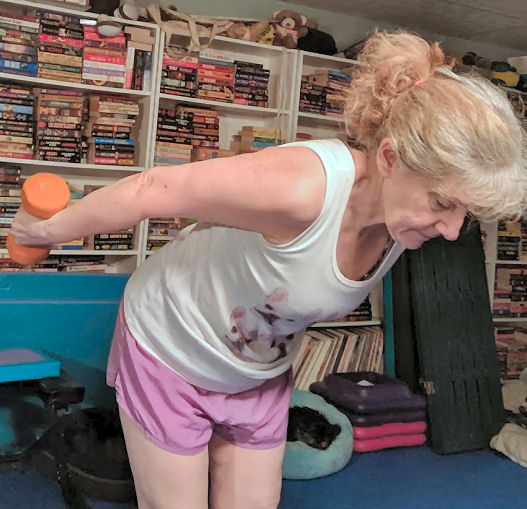
Lifting those weights keeps my bones and muscles strong.

It’s no secret that I exercise multiple times a week. I exercise mostly so that I can do the things I really want to do. Like walk around a store (or a theme park) and run Agility with my dog. But there is no limit to the benefits of exercise in other areas of my life. Like mental clarity. More benefits are sleeping better, and keeping my bones and muscles strong. 

Benefits of exercise to the heart

And the benefits to the heart from exercise have been proven to be limitless. A recent study from the University of Oxford with 90,000 participants showed that the risk of cardiovascular disease was lower in those who were the most active. Five years after the study participants were still benefiting from exercise. 

Daily exercise is crucial for cardiovascular health, blood pressure control, weight loss and overall physical fitness. The researchers also determined that those who exercised had the healthiest BMI (body mass index), were least likely to smoke, and had lower alcohol intake. That’s not surprising. What was surprising, though, was that there was no limit to the cardiovascular benefit the participants received from exercising. “Results showed both moderate and vigorous physical activity drove down instances of cardiovascular disease.”  So – keep exercising and your heart keeps getting the benefits.

Not easy to maintain the level of exercise

It’s not easy to maintain a moderate or vigorous level of exercise a few times a week, though. Just knowing the benefits of exercise is not enough to make you put on your sneakers. Just like with New Year’s resolutions: many people are fired up at the start of the year to “get fit,” and their motivation may last for a few weeks, but they lose interest after a while. They may know the benefits of working out – that’s why they start an exercise in the first place, but that’s not enough to keep them going.

Know your “why”So, as I’ve said before – know your motivator. There must be something that compels you to get on the stationary bike, or climb those stairs, or get on the mat a few times a week besides the benefits to your heart. This is especially important for healthy aging. Know what motivates you, so that you can keep exercising and reap those benefits.

Do a deep dive to settle your brain

Turn your brain off by using more of it. Do a deep dive to settle your brain.

It may seem counterintuitive, but one of the best ways to stop your brain from going in a zillion directions is to hunker down with a difficult project. You know the times when you’re thinking about all the things on your to-do list that you haven’t done, and about your sick dog, and about the war overseas, and about the pandemic, and about when you’re going to have the time to go to the store… When your brain says, “Enough! Or I’m going to explode!” So, to stop your brain from exploding, that’s the time to dive into a complex project, one that requires all your mental powers. Turn your brain off by using more of it.

The harder the project the less you’ll be distracted

It may not make sense at first thought, but, really, it makes perfect sense. The more you have to think about the task you’re performing, the less you’re thinking about other things. And you’ll be distracted less by random thoughts. A paper published a few years ago in the Association for Psychological Science journal studied complexity and distraction. It described how subjects were more likely to finish a complex task on a computer when flashing letters appeared on the screen than an easier task.
I’ve described my process to truly focus on a task, and it goes right along with this study. If you have a task that needs doing but you’re finding it difficult to focus, first decide what you want to get done. Then break it down into manageable chunks so it doesn’t seem overwhelming. Turn off your phone and remove any other distractions you can. Now take a deep breath and clear your mind. And then do it. If you’re finding it hard to concentrate, pick a more complex task to accomplish. You’ll need all your concentration and won’t have the opportunity to be distracted.

Or, if you’re too tired and just don’t have the energy, go to bed. You need more sleep (like most adults). Make any notes about your project off the top of your head. That way they’re not churning along with everything else in your mind. Turn your screens off. And attack that project when you’re fresh and energized tomorrow.

Figure this out before you work out

So you’ve been told you should exercise. It’s not just me who’s telling you that… It’s the Mayo Clinic – did you know that you’ll sleep better if you exercise? And Harvard Medical School – did you know that exercise can help prevent cancer? And yet so many people tend to avoid exercise. It’s easy to not exercise if, for example, your parents were not especially active. And it’s easy to keep on watching TV or reading when a show or book is engrossing. So, what will get you out of the chair? Before you work out, you have to figure out your motivator.

Figure out your motivator

In order to keep on exercising – because exercise is not a “one and done” thing – you have to have a really good reason to keep coming back to it. You’re not going to keep on exercising several days a week if you hadn’t been exercising before, unless you have a particularly strong reason to do it. Because, let’s face it, exercise is not the most fun thing on the planet.

I hate to exercise

A great workout eliminates stress.
I do not like getting sweaty… And yet…

I’ve said it before, I do not like to exercise. Not one little bit. And yet, I’m on my exercise mat or on the treadmill 4 or 5 days every single week. Even after all the years that I’ve been exercising, I despise it. The best part of exercising to me is when I’m done for the day. I do not like getting sweaty and out of breath. And the promise of fighting off cancer or getting better sleep are not good enough reasons to work out. So why do I do it?

My 3 big reasons

  1. I get to eat what I like
  2. I’ll be in shape to run my dog in agility
  3. I’ll be more able to face life’s challenges. I’m a big scaredy-cat. I figure if I have the discipline to do what I don’t like to do, I’ll be better able to face anything life throws at me.

What will make you lace up those sneakers day after day?

Those are my reasons. Everyone does different things for different reasons. The prospect of 7 or 8 uninterrupted hours of sleep might very well be your big motivator.

Or playing with the grandkids in the backyard. Or even having a backyard with a beautiful garden is your reason. Last week’s article was about how gardening can relieve stress. But in order to have a garden you have to do the work. Are you able to dig your garden, to kneel down and get those weeds? Perhaps you’ve figured out your motivator and that garden is it.

The key to getting the benefits of exercise is consistency. You have to keep on exercising to get anything out of it. So, you have to think about what will make you lace up your sneakers and get on that exercise mat. You have to figure out your motivator that will keep you working out six months from now, a year from now, for your best life.

Choose happiness

I choose happiness almost every day. I say almost because, sometimes, reality is too much to bear. Some days the crushing weight of all the bad news in the world combined with bad news closer to home make ear-to-ear grinning happiness impossible.

Day-to-day irritations don’t matter

But most days I can let the day-to-day irritations fade into the background and choose to be happy. Yes, the dog ate something in the yard that didn’t agree with him – all over the rug. And gas went up another dime a gallon. And we had to deal with another unhappy customer wondering why the supply chain issues affected her order.

But those things aren’t enough to make me choose anything other than happiness. 

Think of your happiness as a muscle

Happiness is like a muscle. Use it or lose it. Now, I don’t mean the chocolate cake type of happiness. I mean the deep-down, central to my soul kind of happiness. Yes, chocolate cake will make my taste buds very happy while I’m eating it, but a half hour later it’s a memory. But the happiness I feel when I think of my family, my dogs, my health, the little plants starting to grow outside – that doesn’t go away.

You’re probably laughing to yourself, thinking, “This Fran is a nut. I can’t choose happiness like I would choose a pair of shoes!”

To which I say, “Why not?”

Take responsibility for your own happiness

Deepak Chopra, one of the leading voices in well-being, says that we should take responsibility for our own happiness. It is in our power to be happy. If we leave it to others to make us happy, we can never be happy if we’re alone. That is unacceptable to me. I’m an introvert and I like being by myself much of the time. I like to be happy, so I choose happiness for myself.

I choose happiness.
Work your happiness!

I’ve written about how that happiness comes about in the past. And many times it’s not simply, “OK. I’m happy now.” Sometimes that works, but not very often. What usually does work for me is just closing my eyes and thinking about all the great stuff I have now in my life. I disregard the not-great stuff, because some of that will always be there and there’s not a whole lot I can do about it. 

Or I put on my workout clothes and move. Exercise is a great mood-lifter. After exercise I always feel better than I did before. I not only feel happier but I feel less stressed. And after a shower I feel better still.

If you’re feeling blue, you can do something about it. Choose happiness.

Everyone has their own stuff

Everyone has their own stuff, so they don't care what I'm doing now.
Even if anyone is watching, they don’t care. Everyone has their own stuff

It doesn’t matter what anyone else is doing. Really. Everyone has their own stuff that they’re going through. And you probably don’t enter into the equation. As I’m writing this, today has been a frustrating day. Internet issues, financial institution frustrations, dog training problems. It seems like most things that can go wrong have. I work with my sister – our desks face each other. Our monitors are back to back. I’m having my issues and she’s having hers.

The important things get done

Sometimes I’m a little hesitant to work on certain things during the business day because they don’t contribute to our shared businesses. It doesn’t matter that I’ve done the tasks on those businesses that I’ve set out to do for the day, I’m still hesitant. Stupid, but there you are.

She knows, though. And, you know what? It doesn’t matter. There will always be more to do. Today? The crucial tasks are completed. Tomorrow is another day for the rest of the stuff.

She’s got her own stuff

My sister doesn’t care. She’s got her own stuff to deal with. 

And if I’m focused on what others are thinking about me, I’m not getting anything productive done. Nothing on that to-do list is getting checked off. That article is not getting written. The website changes I wanted to make are not getting done. I need to focus on what’s in front of me.

They don’t care

Just like exercising – if you’re at a gym, no one is watching you. Just about everyone feels self-conscious in their workout gear, even though some will never admit it. Everyone thinks that they look stupid doing some of the exercises. A while ago I wrote about this: “No one is watching” And it holds true for most areas of life.

People, unless they actively ask you to participate in it, are so busy with their own activities that they are not paying attention to others.

They don’t care what you’re doing. What video you’re watching. If you’re listening to a business podcast or a steamy romance audiobook. Unless they ask you a question and expect you to focus on them, they don’t care that much at the moment.

It’s natural that we care what others think

Of course, in the larger scheme of things, it’s totally natural that you care about what others think of you. People are social creatures. We want to be with others, and we want others to want to be with us. It follows that in order for others to want to be with us they care about us in some fashion, so we want others to think well of us. We want to do everything we can to foster our relationships and not alienate anyone.

But for the tiny minutiae of everyday life, no one cares that you’re watching a YouTube video and not doing a crossword puzzle. 

So stop wasting time. Get the important stuff (or the distasteful stuff) done first and then figure out what’s important to you. Decide on the steps you need to take to get there, and do it. If today the thing that’s important to you is regaining your focus, go exercise (because exercise really does increase focus), decide on a plan and get to work.

If you miss a day or two

You’re a few weeks into your new, “healthy you” plan and things are going fine. You have good days and days that it’s a struggle, but you’re making it through. You’ve been sweating up a storm but eating (mostly) right. But you’re starting to wonder, what happens if you miss a day or two. You may have a trip planned and you don’t know if you’ll be able to do your workouts. And if you’re on someone else’s timetable, you don’t know what the meal situation is going to be like. You’re worried that if you miss some time that your plan will be completely undone.

First, take a breath and celebrate

First, take a minute and celebrate your successes! It’s not easy sticking with a healthy plan for a few days, much less a few weeks. And you’ve done it! You’ve stuck with it! You should be incredibly proud of yourself.

But if you miss a couple of days

But that trip is coming up, and you’re concerned. Know that if you miss a day or two, it’s not the end of the road. You may eat things that aren’t on your meal plan. You may miss a few workouts. But you can’t plan your entire life around your workouts. Things happen.

It’s OK. The world will not end.

It’s OK if you miss a day or two. Or even more than that. The world will not end, and you’ll be fine.

The key is to get back on the plan as quickly as you can. And while you may not be able to completely stick with your meal plan while you’re away or your schedule is disrupted, try to eat as sensibly as you can. Don’t think to yourself, “I can’t do my plan, and I don’t want to be impolite and ask for separate food, so that’s it. I’m done.”

Eat sensibly and move!

No. Eat as sensibly as you can. Try to limit high-fat and high-sugar items. Say, “Thank you, but no” to all the sweets your host offers you. (Or just have one of your absolute favorites.) Stick as closely to your own meal plan as possible without being rude.

And get what exercise you can. Suggest walks outside. If you’re staying at a hotel, check out the fitness center. 

Back to normal

You may not want to go all out when you get back to your routine after you miss a day or two.

When you get back to your normal routine, assess where you are. Get back to your healthy eating plan as quickly as possible. You may have gained a couple of pounds, but they’ll come off when you’re back to your plan.

And you may want to ease back into your exercise program a little more slowly. If you miss a day or two, you probably won’t lose momentum. But more than that and if you go back to full exertion, you could be sore for a couple of days. So, modify the intensity a bit for the first few days. And if your muscles are sore the next day, it’s normal. Follow these suggestions to feel better – Drink more, stay active and don’t sit too long. And remember that the sooner you get back to your routine, the easier it will be.

You’ll get back to your fitness routine in no time! You’ll be improving your health and increasing your resilience. There’s no need to quit if you miss a day or two in your fitness journey – you’re just taking a little break.

Maintaining Your Motivation

You’ve been eating right and exercising for a few weeks now. Congratulations! It’s been going pretty well. You’re hanging in there. But every once in a while that muffin looks better than what you planned for breakfast. Or your co-workers are going to your favorite sandwich shop for lunch. And there’s that piece of cake left over from your significant other’s birthday. Maintaining your motivation through all the temptations is really hard.

And it doesn’t get easier.

Five Keys to Maintaining your Motivation

So, how do you maintain your motivation? How do you stick to the plan? These five methods help me maintain a healthy lifestyle every day.

1. Take Each Day as it Comes

One day at a time – Today is the only day that matters in your “healthier you” plan. Yesterday is gone. No matter how “good” you were yesterday (and congratulations for that!), it doesn’t matter today. Keep that date you set up for yourself today in your calendar. (You’re doing that, right? A few weeks ago we talked about forming healthy habits, and a key point was making that recurring appointment with yourself on every day you wanted to exercise.) Make every food decision count especially on days that eating right is a challenge. For every meal you prepare, ask yourself if it’s a good choice for you.

2. Just Get Going

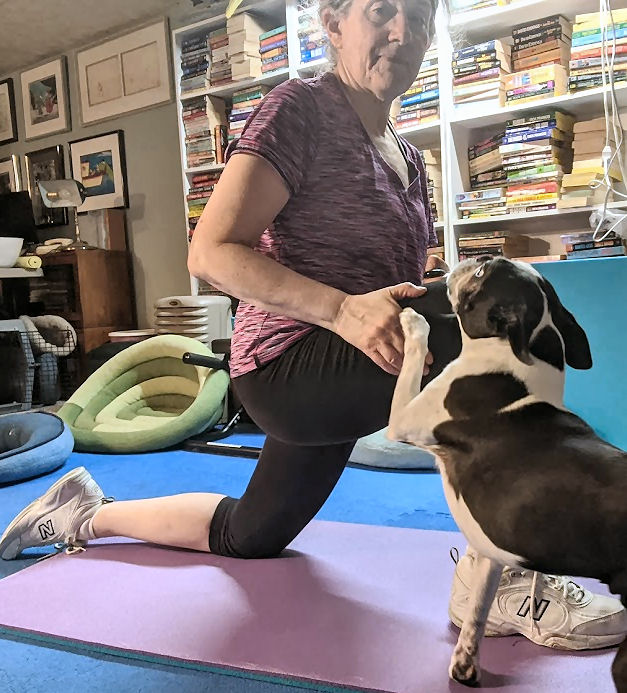
The final stretch with my dog. Just do it, don't agonize over working out. That's maintaining your motivation.

Don’t think too much about your workout preparation – On days that you really don’t want to exercise, just do it. Shake yourself mentally and don’t think about the things you’d rather be doing (like watching TV, reading a book, lying on the couch). Just change into your workout gear and start to exercise. Promise yourself you’ll do 10 minutes of your workout. Before you know it, you’ll be cooling down and looking forward to that final stretch.

3. Reflection

Reflect on how far you’ve come. Just a couple of weeks ago you knew you should start an exercise program and healthy eating plan but were confused about how to start and what to do. And now you’re crushing it! A great way to keep going is to put these reflections in a journal. (Check out my Gratitude and Happiness Journal on Amazon.) Every day, think about what you’re happy you’ve accomplished and write it down. When you go back and read these reflections, you can’t help but feel motivated to carry on. (Writing these thoughts down will also give you a great sense of gratitude, and we know that happiness follows gratitude, and resilience follows happiness and optimism!)

4. Visualize

Visualize yourself maintaining your motivation. Picture yourself eating a plate of vibrant greens with your family and enjoying it! Better yet – you’re all eating that wonderful salad and loving it. Feel how you’d like to be, at the place you enjoy the most, with the people you love most. Picture yourself at a party, enjoying yourself, holding a glass (a champagne flute?) of sparkling water. I can’t tell you to picture yourself exercising and loving it, because I can’t do that myself. But I do it so that the other pictures can become realities.

5. Your “Why”

Your reason for sticking to your plan. Finally, and probably the easiest way of maintaining your motivation – remember your reason for starting in the first place. Whether your reason is for your family or for your own future, remember that. You’re eating right and exercising to lower your blood pressure, to improve your cardiac conditioning, to improve your cognition and memory. 

These five methods will keep you on the straight and narrow. Maintaining your motivation will be easy.