If you miss a day or two

You’re a few weeks into your new, “healthy you” plan and things are going fine. You have good days and days that it’s a struggle, but you’re making it through. You’ve been sweating up a storm but eating (mostly) right. But you’re starting to wonder, what happens if you miss a day or two. You may have a trip planned and you don’t know if you’ll be able to do your workouts. And if you’re on someone else’s timetable, you don’t know what the meal situation is going to be like. You’re worried that if you miss some time that your plan will be completely undone.

First, take a breath and celebrate

First, take a minute and celebrate your successes! It’s not easy sticking with a healthy plan for a few days, much less a few weeks. And you’ve done it! You’ve stuck with it! You should be incredibly proud of yourself.

But if you miss a couple of days

But that trip is coming up, and you’re concerned. Know that if you miss a day or two, it’s not the end of the road. You may eat things that aren’t on your meal plan. You may miss a few workouts. But you can’t plan your entire life around your workouts. Things happen.

It’s OK. The world will not end.

It’s OK if you miss a day or two. Or even more than that. The world will not end, and you’ll be fine.

The key is to get back on the plan as quickly as you can. And while you may not be able to completely stick with your meal plan while you’re away or your schedule is disrupted, try to eat as sensibly as you can. Don’t think to yourself, “I can’t do my plan, and I don’t want to be impolite and ask for separate food, so that’s it. I’m done.”

Eat sensibly and move!

No. Eat as sensibly as you can. Try to limit high-fat and high-sugar items. Say, “Thank you, but no” to all the sweets your host offers you. (Or just have one of your absolute favorites.) Stick as closely to your own meal plan as possible without being rude.

And get what exercise you can. Suggest walks outside. If you’re staying at a hotel, check out the fitness center. 

Back to normal

You may not want to go all out when you get back to your routine after you miss a day or two.

When you get back to your normal routine, assess where you are. Get back to your healthy eating plan as quickly as possible. You may have gained a couple of pounds, but they’ll come off when you’re back to your plan.

And you may want to ease back into your exercise program a little more slowly. If you miss a day or two, you probably won’t lose momentum. But more than that and if you go back to full exertion, you could be sore for a couple of days. So, modify the intensity a bit for the first few days. And if your muscles are sore the next day, it’s normal. Follow these suggestions to feel better – Drink more, stay active and don’t sit too long. And remember that the sooner you get back to your routine, the easier it will be.

You’ll get back to your fitness routine in no time! You’ll be improving your health and increasing your resilience. There’s no need to quit if you miss a day or two in your fitness journey – you’re just taking a little break.

The other piece of the puzzle for weight loss

If you’re serious about wanting to lose weight, exercise is important. Exercise is more important for lowering blood pressure and reducing your risk of certain diseases. It’s also important for building strength and bone mass. What you eat is the more important piece of the puzzle for weight loss. 

The formula for losing weight is simple: consume fewer calories than you use. The number of calories that you use exercising can be large, but not nearly as large as it needs to be in order for you to lose pounds. Even the Mayo Clinic says that diet is more important than exercise when it comes to losing weight.

Diet is a 4-letter word

What you eat is most important in the weight loss puzzle

Yes, diet is a nasty word. But it’s also what we consume every day. Our diet is just that – what we eat. The word is neither good nor bad. It’s just a word. What can be good or bad are the foods that make up our diet. 

You’ve heard the “experts” promoting the “South Beach Diet,” the “Atkins Diet,” the “Mediterranean Diet,” “Keto,” gluten-free diet, Pescatarian diet, Intermittent Fasting – the list is endless. What works for one person may not work for you. 

What does work

Change your mindset: Stop thinking of “diet” as a bad thing. My own diet includes lots of really “healthy food,” but also ice cream, bread and donuts. None of these are bad themselves. What is “bad” is when you overload your diet with processed foods high in sugar and fat. My motto: (like Benjamin Franklin) “Everything in moderation.”

So, if you’re really serious about losing weight, do some research about food plans. What’s included, what’s not included, the long-term prospects of sticking with it. Figure out what appeals to you. Try it for a few weeks. See if it works, and if you can live with it. If you need to modify the plan – it’s your body. Do what’s right for you. Keep a food journal – write down every morsel of food that goes in your mouth. Be religious about this. You probably don’t realize everything you eat. And that can sabotage your results. 

Losing weight is hard, but the more you know about what it takes to lose weight and be healthy, the better your chances of success.

What happens after you start

Congratulations! You’ve made the decision to start exercising. You’ve chosen the program you’re going to use. You have your workout gear and a spiffy new pair of sneakers. Now what? What happens after you start to exercise?

Commitment to your health

It’s been a few days. The initial exhilaration  of the newness of your exercise routine has worn off. You’re starting to realize that exercise may not get easier as time goes on. 

It never gets easier even after you start to exercise.

You’re right! And that’s the point. Exercise will not get easier. In order for you to get all the benefits of exercise (improved cognition, increase bone density, increase strength), you have to challenge yourself every day. Of course, the point is not to challenge yourself until you’re ready to drop, but at the end of a workout you should feel like you really can’t do any more without some recovery time. Your final cooldown and stretch should be absolute bliss. After a cardio workout you should be warm and sweating. And after a strength workout you should feel like you couldn’t do another push-up if your life depended on it – at least for a half hour or so.

You know that old saying, “When the going gets tough, the tough get going?” The same applies to exercise. Exercise is tough – you’re tougher. You’re exercising to reap those health benefits I mentioned above. And know that you’re not alone. Exercise is hard every day for me. It should be hard every day for everyone.

Make it a habit

A couple of weeks ago I wrote about habits. It takes about 3 weeks for anything to become a habit. If you do the same thing at pretty much the same time every day (or almost every day) for 3 weeks, the better the chances that it will become a habit. The same for exercise. I work out in the late afternoon 4 or 5 times a week. I get home, walk the dogs, check on the bearded dragon, get the mail, change my clothes and exercise. That’s my routine. We humans love routine. Exercise is a part of mine. A few weeks after you start to exercise, it will be part of your routine too. But before exercise becomes a routine, you must put thought and deliberation into it.

I’ve emphasized the use of a calendar or planner in the past. If you’re serious about making that commitment to your health, make appointments with yourself to exercise. (Here is Zapier’s ranking of the best calendar apps for 2021.) Four days a week for the next three weeks – just write it in or make a repeating event on your digital calendar. And keep that date with yourself. You’ll find that in a few weeks, you’ll start your workout routine as a matter of course. Remember that you’re doing this not only for you, but for those who depend on you. Like an oxygen mask on an airplane – when they drop, put yours on first so that you can take care of others.

Positive reinforcement works for me

In addition to writing articles about fitness and trying to inspire other (mostly) women over … a certain age …. to become more fit, I train my dogs using positive reinforcement. It occurred to me lately that positive reinforcement works for me, too. 

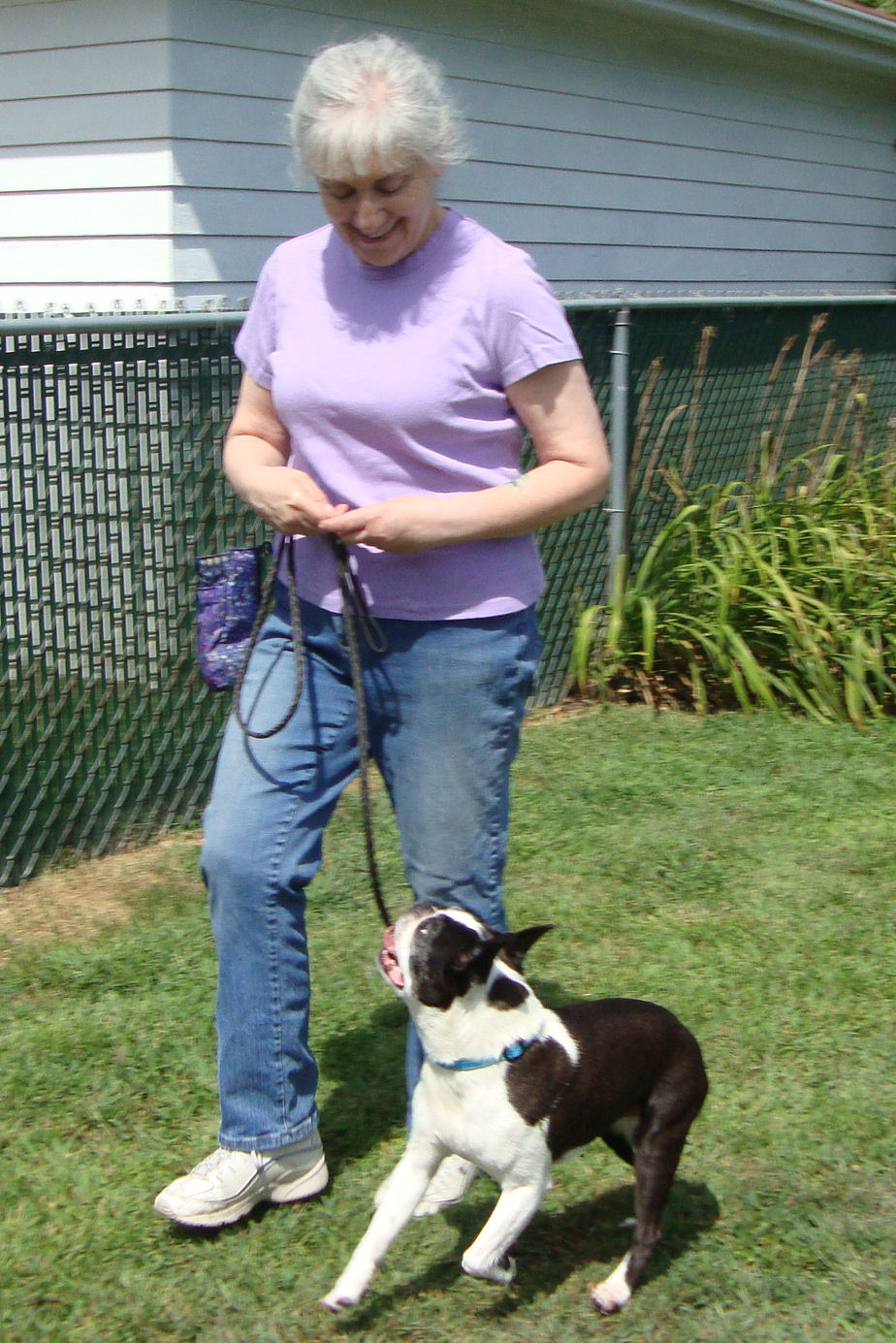
Booker is heeling at Fran's side: positive reinforcement works

In the dog training world, many trainers, including me, have moved to a place where we reward the dog for doing what we ask them to and ignore other behaviors (unless they do something really outrageously wrong). A big difference from about twenty years ago (maybe less than that), when it was a common practice for handlers to jerk the dog on a choke chain into place and hurl a jar filled with noisy pebbles at a dog. Fear was the common motivator in dog training. Now our dogs learn to think and make correct choices.

Now my dog walks at my side when I tell him to, looking up at me for his next “assignment.” I reward that behavior.

How does that positive reinforcement work for me?

I know that there are certain “behaviors” that I’m supposed to do. Eat well. Go to work. Be nice to other people. Exercise a few times a week. If I do all that, I give myself a reward. That reward could be something as insignificant as a shower after my workout. Maybe an extra piece of tomato on my sandwich. Why so minimal? Because these things have become habits for me. 

The newer a behavior is, when I’m trying to form a new habit, the bigger and better the reward. The same for dog training. If I’m just starting to teach my dog to walk close to my left side, I’ll give him a jackpot reward the first couple of times he finds that position on his own. That way he’ll be more likely to repeat the behavior! But after a period of time, say a few weeks, my dog has been walking in heel position on his own for all that time. So, a periodic reward will spark his enthusiasm and keep him there. In the same vein, after a particularly tough workout, I might reward myself with an extra long stretch. 

Positive reinforcement for the masses

Lately we’ve seen states and municipalities reward residents for getting COVID vaccines. They’re rewarding a behavior that people were either resistant to or saw no benefit in for themselves. That’s positive reinforcement working in a very big way. 

Positive reinforcement works for me, it’ll work for you. And it’s certainly a lot more palatable than punishing myself for something I didn’t do.

Yet another study supports what we know …

Another study that supports what we already know: that those who exercise  are in better health than those who don’t.

Cycling and exercise for health

82-year-old Norman Lazarus, a professor emeritus at London’s Kings College, requested that a study be performed on the health of older active cyclists. King’s College and the University of Birmingham took him up on it. Researchers compared 125 amateur cyclists, ages 55 through 79, with a group of people ages 57 through 80 and with a younger group ages 20 through 36. All of the noncycling group were healthy but did not exercise regularly.

Lazarus had noted that he and his riding group were not experiencing many of the frailties, such as joint problems or chronic illness, that affect so many other people as they age. His group had been avid cyclists for most of their lives.

Less evidence of aging in cyclers

The researchers found that those who exercised – in this case cycled – regularly did not show evidence of the outward signs of aging.

The male cyclists in the study had to be able to ride 62 miles in 6½ hours, and females had to be able to ride 37 miles in 5½ hours, according to the study, published in the journal Aging Cell. I’m not a cyclist but seems like a fairly intense regimen.

Less loss of strength

In a series of lab tests, researchers found cyclists did not lose muscle mass and strength like the noncyclists did. The cyclists also stopped the clock on increased body fat and cholesterol, and the men’s testosterone levels remained high.

Improved immune systems

One of the most surprising findings was that the cyclists’ immune systems were equivalent to those of healthy young people in the study, as measured by the presence of immune cells, known as T-cells. The cells are produced by the thymus gland and typically start to decrease as the thymus begins to shrink after age 20. Depleted immune systems are one of the greatest barriers to health in the elderly.

Intense exercise is the key

We know from other studies that cycling is not the important part of this – the intense exercise is.

The CDC recommends that adults get 150 minutes a week of moderately intense exercise or 75 minutes of vigorous exercise.

The moral

The moral here – do something! It’s better than nothing. And even if you can’t do even moderately intense exercise now, you soon will be! So get moving!

Stay in your rut!

We love routine! I think we’re all happiest when we have a schedule that we can stick with. I know I am.

Get up at (pretty much) the same time everyday.

Eat meals at (pretty much) the same time.

Go to (pretty much) the same place every day.

Exercise at (pretty much) the same time every day, or as my schedule dictates.

Go to bed at the same time every day.

Until something happens to disrupt the schedule.

Like an injury.

Then it’s a major obstacle to do regular things. Even getting out of bed can be a chore.

Making meals for myself and the dogs takes twice as long as it should.

Walking to and getting in the car? Agony.

That’s what happened to me the last few days. Yes, things were not easy. Routine things took twice as long as usual – or longer.

But, the closer I came to sticking with my regular schedule, the happier I felt. The closer I felt to being on track.

Of course, the workouts were not my usual workouts, because I physically could not do the exercises I wanted to.

But I made sure that I did a workout.

Meals? It was more important than ever to eat right. Eating healthy is one of the best ways to stay on the fitness track.

And getting up to get water kept me moving. To the water jug (and the bathroom). If you can, and if it’s in alignment with your doctor’s or your PT’s orders, keep moving. As I said earlier in the week, movement will get you back to normal quicker than sitting on the couch will.

And the more in line with my regular schedule I was, the closer I was to feeling more normal.

So, stay in your rut as much as you can. If something throws a monkey wrench into the works, work around it.

So, after an injury – Eat right. Drink plenty of water. And move!

Pain and movement

One ice pick for bursitis

I’ve told you that I have bursitis in both hips. Bursitis pain? Think of an ice pick inserted into the hip joint. And then hit it with a hammer.

But, thankfully, my bursitis pain is under control … most of the time.

Another ice pick for sciatica

Add sciatica to the bursitis and it’s really fun. Sciatica pain? Think of an ice pick jabbing you from your lower back down each leg. And you never know when that ice pick will strike.

And a combo ice pick

So when you mix sciatica and bursitis, you get spasms. Multiple ice picks going at your hips, your back, your legs. You can’t move. You can’t breathe.

You’d do anything to not feel that pain. A severe bout of spasms hit me a few years ago, and I started doing research on what, if anything, could be done…

Remedies?

Ice packs. Heat packs. A strange and kind of nasty potion of Certo and grape juice. Cortizone shots.

Temporary fixes at best. I wanted something long-lasting, so that I wouldn’t feel that pain again.

I found that the solution is movement. Just move. Don’t sit for an extended period of time.

Teeter-totter flare-up

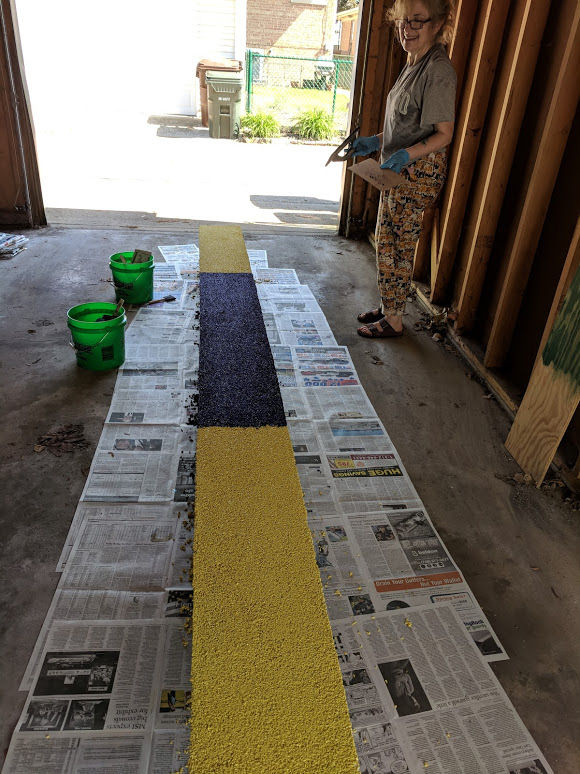
You know that I enjoy training my dog in agility and competing with him, and my sister enjoys agility with her dog as well. The contact obstacles (A-Frame, Dog Walk, Teeter-Totter) are the hardest to train because it’s difficult to train all the time on these obstacles. We don’t all have the luxury of a big training area. The hardest is the Teeter – it moves, it’s narrow, it makes noise.  My sister and I do have a back yard, and even if it’s too cold or too hot to spend a lot of time training outside, a few minutes is doable. So we decided to build a Teeter. We’ve put together a base, and wanted to rubberize the board for better footing for the dogs.

So rubberizing the Teeter board was our project this last weekend. That’s me in the picture above, with the just-completed teeter. You can’t see the sweat, nor can you see the pain just starting to jab my hip and leg.

Yup – a dreaded flare-up of my bursitis and sciatica. I immediately (well, after my shower) resolved to get up every hour and move around. I hoped to avoid the spasms… I also resolved to stay hydrated. Hydration also helps to avoid spasms. Plus, I’d have to get up and walk to the sink to get more water. (Not to mention the washroom…)

It’s been a few days, and, thankfully, no spasms. A little pain remains, and I’m still getting up and walking around every hour. It really does help.


In a funk?

You may have sensed from my last post that I’m in a funk. I’m feeling my age. I had to really push myself yesterday to do my workout, and the day before that wasn’t great either.

Some days are like that. Some weeks are like that. The cycles we go through in our lives leave an impression. The seasons affect us. The weather affects us.

It had been cool and rainy here for days, which certainly did not help things. Joints were stiff and creaky. People were in bad moods.

When I’m in a bad mood, I don’t want to do anything. I don’t want to associate with anyone. I don’t want to talk to anyone. Those days I wish I could put myself in a bubble with a “Do Not Disturb!” sign on me.

Of course, that’s not possible.

So what I’ve learned to do is paste a smile on my face during working hours and try to be as helpful as humanly possible to the people I meet. And hope that the smiles I receive in return will make an impression on my brain and stick there!

It’s really hard to keep that up indefinitely, though. On days like that, it’s all I can do to be nice to the dogs!

And working out yesterday was not fun. I did not want to do it, but I made myself. I wanted to quit after every exercise for the first half of the workout. By the second half, I conned myself into finishing – “You’re more than halfway done. You can do this!” And I did. It wasn’t easy, it wasn’t fun, but it was done!

And afterward I took a long warm shower with “Citrus Fresh” essential oil dropped onto the baking soda disc, which was delightful. And I felt better when it was done – quite virtuous!

It’s nice and bright and warm today, so hopefully that will put a more positive spin on things.

Let me know how you combat your blue funk days!

Feeling my age…

Every once in a while my body reminds me that I’m over 60. (Yikes! How did that happen?! Anyone else feel that way?)

This morning I woke up stiff. My back hurt, my knees hurt, I did something to my hamstring, my ankle hurts, my hands hurt.

I guess the combination of standing around all weekend on concrete at an agility trial and a plyometric workout yesterday was too much for the old bod.

I not only enjoy running my dog in agility, I also enjoy watching others compete. I can see how people handle especially tricky parts of the course to figure out what works and what doesn’t work. While the agility course itself was on turf, spectators watched from the concrete floor. And I’m so short that sitting down means that I can’t see… And I certainly wasn’t going to skip or change yesterday’s workout because I was on my feet all weekend. All the jumping in that plyometric workout helps keep me agile.

But I knew that if I cater to my aches and pains, I’d just be complaining all day and moving would be even more difficult. So, I got up, stretched, and went through my normal morning routine. It may have been a tad bit slower than normal, but things needed to get done.

I’m more careful today to get up and walk around more often so my hips and knees don’t stiffen up even more. And I am trying to drink more water to stay hydrated. This also helps keep everything moving.

It’s also important that I not skip today’s workout. I have an upper body workout planned, focusing on the arms, chest, back and core. Yes, the lower body is also involved (no sitting!), but the focus will be on the upper body. It’s imperative to keep moving. Why?

Dog obedience class is tonight!

Bored with your workout?

Are you bored with doing the same kind of workout day after day? You know that I’m not a fan of working out. I do it because I want to do other active things. And the workouts that I do are short, so I’m not getting bored during the workout. I switch off between a couple of workout programs. 21 Day Fix and 21 Day Fix Extreme are incredibly effective. And PiYo is great for getting strong and lean. But that still doesn’t mean that I don’t get tired of doing the same programs.

So I switch it up. Every couple of months I’ll do a week of yoga. I love yoga – nothing gives me the sense of peace and calm as a good yoga practice. Or leaves me feeling at one with my body. Or I’ll do a week of Pilates. I don’t love it as much as yoga, but it still gives me that strengthening and stretching I need. Or I’ll do a couple of days in a week on the treadmill. I really hate running (more than other workouts!), but I enjoy competing with my dog in agility. He’s a fast little dog, so I need more speed and endurance.

And then after I have my switch-off days, I’ll go back to my old standards and enjoy them more. I’ll do the plyometric workout in the 21 Day Fix Extreme program and realize again that jumping the right way is really not bad for my knees. Or I’ll do the “Drench” workout in PiYo and remember that I really do love the flow sequence.

So, when you start to dread your workouts (even more than usual), switch it up for a week. Do a different program for a while. You’ll engage your brain, which is always good. And you’ll also be cross-training, confusing your muscles, which makes your workouts more effective.